LMV115
LMV115 is GSM Baseband 30MHz 2.8V Oscillator Buffer manufactured by National Semiconductor.
Description
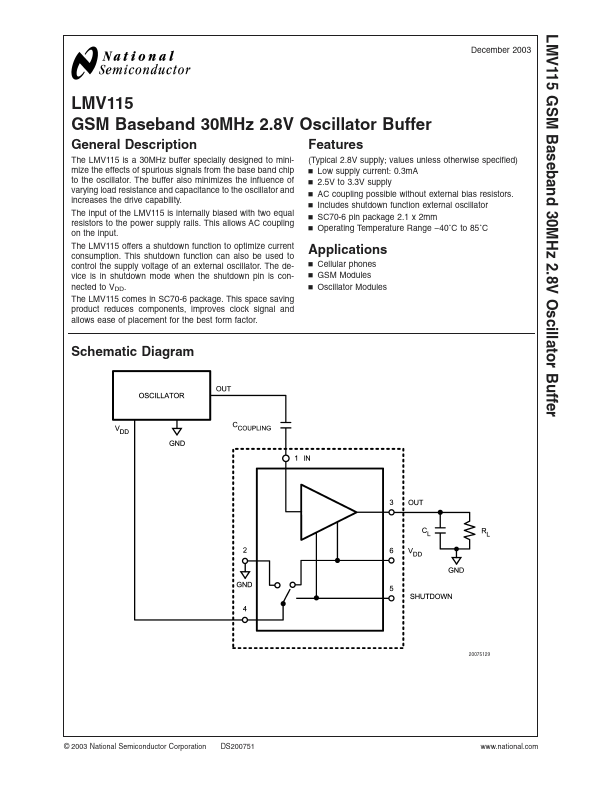
The LMV115 is a 30MHz buffer specially designed to minimize the effects of spurious signals from the base band chip to the oscillator. The buffer also minimizes the influence of varying load resistance and capacitance to the oscillator and increases the drive capability. The input of the LMV115 is internally biased with two equal resistors to the power supply rails. This allows AC coupling on the input. The LMV115 offers a shutdown function to optimize current consumption. This shutdown function can also be used to control the supply voltage of an external oscillator. The device is in shutdown mode when the shutdown pin is connected to VDD. The LMV115 es in SC70-6 package. This space saving product reduces ponents, improves clock signal and allows ease of placement for the best form factor.
Features
(Typical 2.8V supply; values unless otherwise specified) n Low supply current: 0.3m A n 2.5V to 3.3V supply n AC coupling possible without external bias resistors. n Includes shutdown function external oscillator n SC70-6 pin package 2.1 x 2mm n Operating Temperature Range
- 40˚C to 85˚C
Applications n Cellular phones n GSM Modules n Oscillator Modules
Schematic Diagram
© 2003 National Semiconductor Corporation
DS200751
.national.
Absolute Maximum Ratings (Note 1)
If Military/Aerospace specified devices are required, please contact the National Semiconductor Sales Office/ Distributors for availability and specifications. ESD Tolerance Human Body Model Machine Model Supply Voltage (V+
- V- ) Output Short Circuit to V
+
Junction Temperature (Note 6) Mounting Temperature Infrared or Convection (20 sec.)
+150˚C 235˚C
2000V (Note 2) 150V (Note 3) 3.6V (Note 4), (Note 5) (Note 4), (Note 5)
- 65˚C to +150˚C
Operating Ratings (Note 1)
Supply Voltage (V+
- V- ) Temperature Range (Note 6), (Note 7) SC70-6 2.5V to 3.3V
- 40˚C to +85˚C 414˚C/W
Package Thermal Resistance (Note 6), (Note 7)
Output Short Circuit to V- Storage Temperature...