LMV651
LMV651 is Low Power Amplifier manufactured by National Semiconductor.
Description
National’s LMV651 is a high performance, low power op amp IC implemented in National’s advanced VIP50 process. The unity gain stable LMV651 features
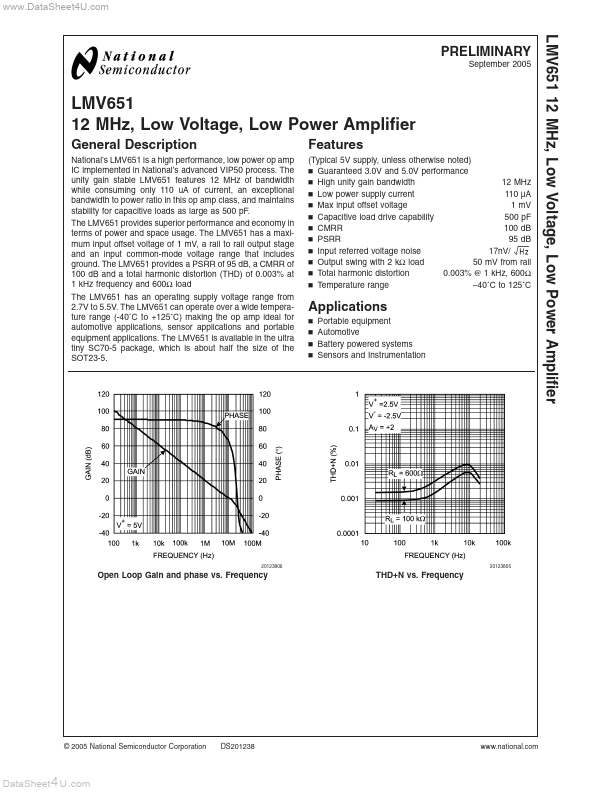
12 MHz of bandwidth while consuming only 110 u A of current, an exceptional bandwidth to power ratio in this op amp class, and maintains stability for capacitive loads as large as 500 p F. The LMV651 provides superior performance and economy in terms of power and space usage. The LMV651 has a maximum input offset voltage of 1 m V, a rail to rail output stage and an input mon-mode voltage range that includes ground. The LMV651 provides a PSRR of 95 d B, a CMRR of 100 d B and a total harmonic distortion (THD) of 0.003% at 1 k Hz frequency and 600Ω load The LMV651 has an operating supply voltage range from 2.7V to 5.5V. The LMV651 can operate over a wide temperature range (-40˚C to +125˚C) making the op amp ideal for automotive applications, sensor applications and portable equipment applications. The LMV651 is available in the ultra tiny SC70-5 package, which is about half the size of the SOT23-5.
Features
(Typical 5V supply, unless otherwise noted) n Guaranteed 3.0V and 5.0V performance n High unity gain bandwidth 12 MHz n Low power supply current 110 µA n Max input offset voltage 1 m V n Capacitive load drive capability 500 p F n CMRR 100 d B n PSRR 95 d B n Input referred voltage noise 17n V/ n Output swing with 2 kΩ load 50 m V from rail n Total harmonic distortion 0.003% @ 1 k Hz, 600Ω n Temperature range
- 40˚C to 125˚C
Applications n n n n Portable equipment Automotive Battery powered systems Sensors and Instrumentation
Open Loop Gain and phase vs. Frequency
THD+N vs. Frequency
© 2005 National Semiconductor Corporation
DS201238
.national.
Data Sheet 4 U .
..
Absolute Maximum Ratings (Note 1)
If Military/Aerospace specified devices are required, please contact the National Semiconductor Sales Office/ Distributors for availability and specifications. ESD Tolerance (Note 2) Human...