LMV842
LMV842 is Wide Supply Range Operational Amplifiers manufactured by National Semiconductor.
Description
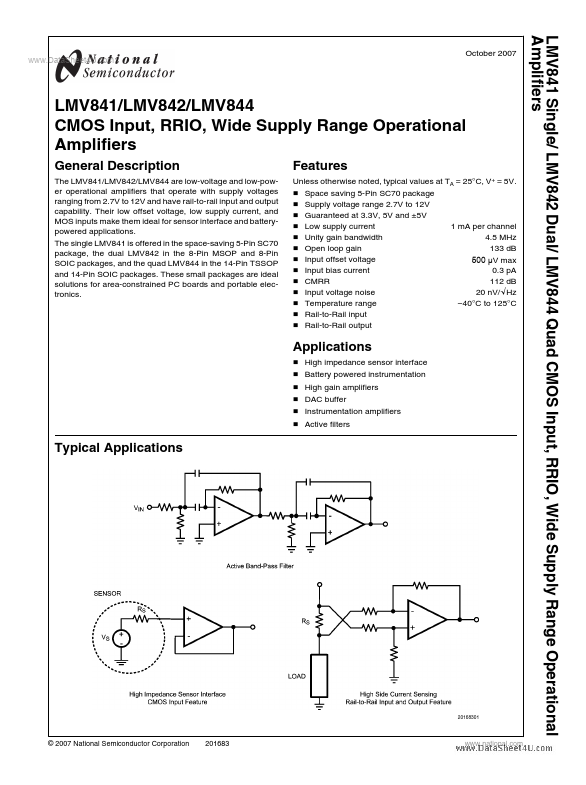
The LMV841/LMV842/LMV844 are low-voltage and low-power operational amplifiers that operate with supply voltages ranging from 2.7V to 12V and have rail-to-rail input and output capability. Their low offset voltage, low supply current, and MOS inputs make them ideal for sensor interface and batterypowered applications. The single LMV841 is offered in the space-saving 5-Pin SC70 package, the dual LMV842 in the 8-Pin MSOP and 8-Pin SOIC packages, and the quad LMV844 in the 14-Pin TSSOP and 14-Pin SOIC packages. These small packages are ideal solutions for area-constrained PC boards and portable electronics.
Features
Unless otherwise noted, typical values at TA = 25°C, V+ = 5V.
- Space saving 5-Pin SC70 package
- Supply voltage range 2.7V to 12V
- Guaranteed at 3.3V, 5V and ±5V 1 m A per channel
- Low supply current 4.5 MHz
- Unity gain bandwidth 133 d B
- Open loop gain 500 μV max
- Input offset voltage 0.3 p A
- Input bias current 112 d B
- CMRR 20 n V/√Hz
- Input voltage noise
- 40°C to 125°C
- Temperature range
- Rail-to-Rail input
- Rail-to-Rail output
Applications
- -
- -
- -
High impedance sensor interface Battery powered instrumentation High gain amplifiers DAC buffer Instrumentation amplifiers Active filters
Typical Applications
© 2007 National Semiconductor Corporation
.national.
LMV841 Single/ LMV842 Dual/ LMV844 Quad
..
Absolute Maximum Ratings (Note 1)
If Military/Aerospace specified devices are required, please contact the National Semiconductor Sales Office/ Distributors for availability and specifications. ESD Tolerance (Note 2) Human Body Model Machine Model VIN Differential Supply Voltage (V+
- V- ) Voltage at Input/Output Pins Input Current Storage Temperature Range Junction Temperature (Note 3) 2 k V 200V ±300 m V 13.2V V++0.3V, V-
- 0.3V 10 m A
- 65°C to +150°C +150°C (Note 4)
Soldering Information Infrared or Convection (20 sec) Wave Soldering Lead Temp. (10 sec)
235°C 260°C
Operating Ratings
Temperature Range (Note 3)...