LP2960
LP2960 is Adjustable Micropower 0.5A Low-Dropout Regulators manufactured by National Semiconductor.
Description
The LP2960 is a micropower voltage regulator with very low dropout voltage (12 m V typical at 1 m A load and 470 m V typical at 500 m A load) and very low quiescent current (450 µA typical at 1 m A load). The LP2960 is ideally suited for battery-powered systems: the quiescent current increases only slightly at dropout, which prolongs battery life. The LP2960 retains all the desirable characteristics of the LP2953, and offers increased output current. The error flag goes low any time the output drops more than 5% out of regulation. Reverse battery protection is provided. The LP2960 requires only 10 µF of output capacitance for stability (5V version). The internal voltage reference is made available for external use, providing a low-T.C. reference with very good regulation characteristics. The parts are available in 16-pin plastic DIP and 16-pin surface mount packages.
Features n n n n n n n n n n n n Output voltage adjusts from 1.23V- 29V Guaranteed 500 m A output current 5V and 3.3V versions available 16-pin DIP and 16-pin SO packages Low dropout voltage Low quiescent current Tight line and load regulation Low temperature coefficient Current limiting and thermal protection Logic-level shutdown Can be wired for snap-ON and snap-OFF Reverse battery protection
Applications n n n n High-efficiency linear regulator Regulator with under-voltage shutdown Low dropout battery-powered regulator Cellular telephones
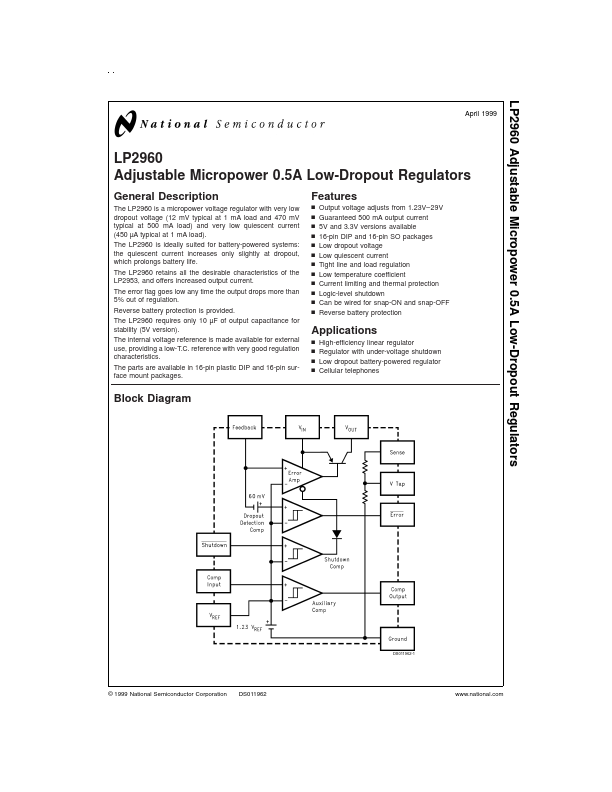
Block Diagram
DS011962-1
© 1999 National Semiconductor Corporation
DS011962
.national.
Absolute Maximum Ratings (Note 1)
If Military/Aerospace specified devices are required, please contact the National Semiconductor Sales Office/ Distributors for availability and specifications. Storage Temperature Range Operating Junction Temperature Range LP2960AI/LP2960I
- 65˚C to +150˚C
Lead Temperature (Soldering, 5 sec.) Power Dissipation (Note 2) Input Supply Voltage Feedback Input Voltage (Note 3) parator Input Voltage (Note 4) parator Output Voltage (Note 4)...