CF5036
CF5036 is 2.5V LVPECL Output Oscillator ICs manufactured by Nippon Precision Circuits.
Features
2.375 to 3.6V operating supply voltage range Operating frequency range (varies with version)
- 50MHz to 700MHz fundamental oscillation
- 50MHz to 250MHz 3rd overtone oscillation
- 40 to 85°C operating temperature range Differential LVPECL output 50Ω output load (terminated to VCC
- 2V)
Standby function
- Outputs are high impedance when OE is LOW. (oscillator stops) Power-saving pull-up resistor built-in (pin OE) Bi CMOS process Chip form (CF5036××)
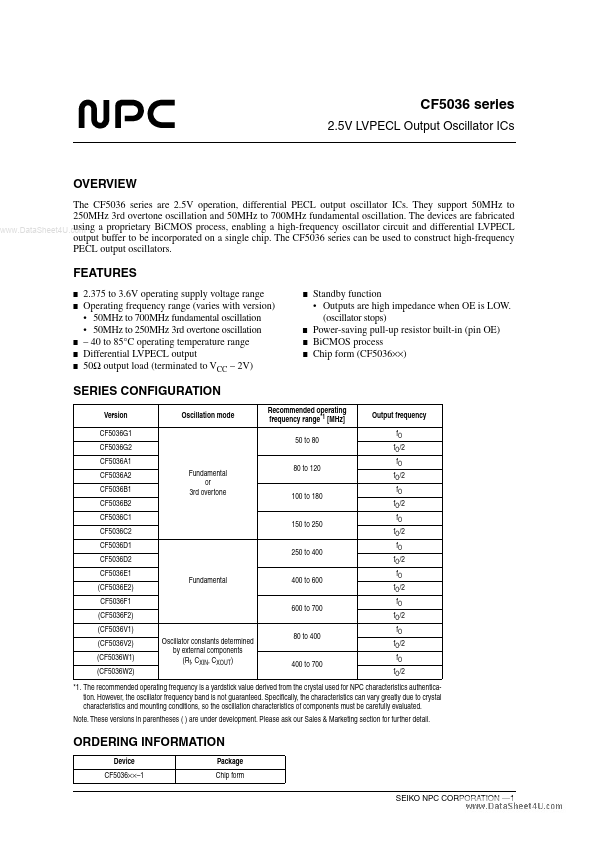
SERIES CONFIGURATION
Version CF5036G1 CF5036G2 CF5036A1 CF5036A2 CF5036B1 CF5036B2 CF5036C1 CF5036C2 CF5036D1 CF5036D2 CF5036E1 (CF5036E2) CF5036F1 (CF5036F2) (CF5036V1) (CF5036V2) (CF5036W1) (CF5036W2) Oscillator constants determined by external ponents (Rf, CXIN, CXOUT) Fundamental Fundamental or 3rd overtone Oscillation mode Remended operating frequency range- 1 [MHz] 50 to 80 Output frequency f O f O/2 f O f O/2 f O f O/2 f O f O/2 f O f O/2 f O f O/2 f O f O/2 f O f O/2 f O f O/2
80 to 120
100 to 180
150 to 250
250 to 400
400 to 600
600 to 700
80 to 400
400 to 700
- 1. The remended operating frequency is a yardstick value derived from the crystal used for NPC characteristics authentication. However, the oscillator frequency band is not guaranteed. Specifically, the characteristics can vary greatly due to crystal characteristics and mounting conditions, so the oscillation characteristics of ponents must be carefully evaluated. Note. These versions in parentheses ( ) are under development. Please ask our Sales & Marketing section for further detail.
ORDERING INFORMATION
Device CF5036××- 1 Package Chip form SEIKO NPC CORPORATION
- 1
CF5036 series
PAD LAYOUT
(Unit: µm)
OUT OUTN VCC2 OE
8 7 6 5
(1100,1300)
TEST
.....