Datasheet4U Logo Datasheet4U.com

74ACT245 - Octal Bidirectional Transceiver

Download the 74ACT245 datasheet PDF. This datasheet also covers the 74AC245 variant, as both devices belong to the same octal bidirectional transceiver family and are provided as variant models within a single manufacturer datasheet.

General Description

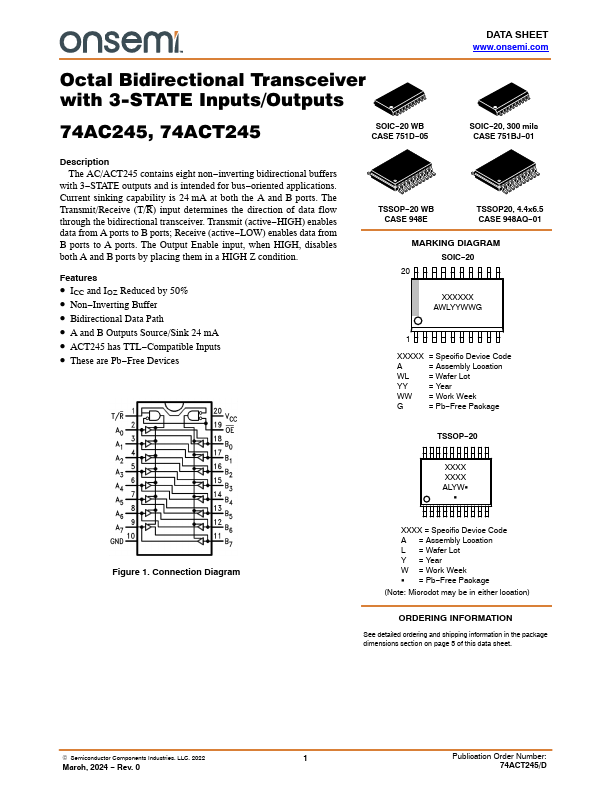
The AC/ACT245 contains eight non inverting bidirectional buffers with 3 STATE outputs and is intended for bus

oriented applications.

Current sinking capability is 24 mA at both the A and B ports.

Key Features

  • ICC and IOZ Reduced by 50%.
  • Non.
  • Inverting Buffer.
  • Bidirectional Data Path.
  • A and B Outputs Source/Sink 24 mA.
  • ACT245 has TTL.
  • Compatible Inputs.
  • These are Pb.
  • Free Devices TSSOP.
  • 20 WB CASE 948E TSSOP20, 4.4x6.5 CASE 948AQ.
  • 01.

📥 Download Datasheet

Note: The manufacturer provides a single datasheet file (74AC245-ONSemiconductor.pdf) that lists specifications for multiple related part numbers.

Datasheet Details

Part number 74ACT245
Manufacturer onsemi
File Size 397.02 KB
Description Octal Bidirectional Transceiver
Datasheet download datasheet 74ACT245 Datasheet

Full PDF Text Transcription (Reference)

The following content is an automatically extracted verbatim text from the original manufacturer datasheet and is provided for reference purposes only.

View original datasheet text
DATA SHEET www.onsemi.com Octal Bidirectional Transceiver with 3-STATE Inputs/Outputs 74AC245, 74ACT245 SOIC−20 WB CASE 751D−05 SOIC−20, 300 mils CASE 751BJ−01 Description The AC/ACT245 contains eight non−inverting bidirectional buffers with 3−STATE outputs and is intended for bus−oriented applications. Current sinking capability is 24 mA at both the A and B ports. The Transmit/Receive (T/R) input determines the direction of data flow through the bidirectional transceiver. Transmit (active−HIGH) enables data from A ports to B ports; Receive (active−LOW) enables data from B ports to A ports. The Output Enable input, when HIGH, disables both A and B ports by placing them in a HIGH Z condition.