Datasheet4U Logo Datasheet4U.com

MC10EP29 - 3.3V / 5V ECL Dual Differential Data and Clock D Flip-Flop

Download the MC10EP29 datasheet PDF. This datasheet also covers the MC100EP29 variant, as both devices belong to the same 3.3v / 5v ecl dual differential data and clock d flip-flop family and are provided as variant models within a single manufacturer datasheet.

General Description

The MC10/100EP29 is a dual master slave flip

flop.

Key Features

  • fully differential Data and Clock inputs as well as outputs. The MC10/100EP29 is functionally equivalent to the MC10/100EL29. Data enters the master latch when the clock is LOW and transfers to the slave upon a positive transition on the clock input. The differential inputs have special circuitry which ensures device stability under open input conditions. When both differential inputs are left open the D input will pull down to VEE and the D input will bias around VCC/2. The outputs will go to a.

📥 Download Datasheet

Note: The manufacturer provides a single datasheet file (MC100EP29_ONSemiconductor.pdf) that lists specifications for multiple related part numbers.

Datasheet Details

Part number MC10EP29
Manufacturer onsemi
File Size 103.84 KB
Description 3.3V / 5V ECL Dual Differential Data and Clock D Flip-Flop
Datasheet download datasheet MC10EP29 Datasheet

Full PDF Text Transcription (Reference)

The following content is an automatically extracted verbatim text from the original manufacturer datasheet and is provided for reference purposes only.

View original datasheet text
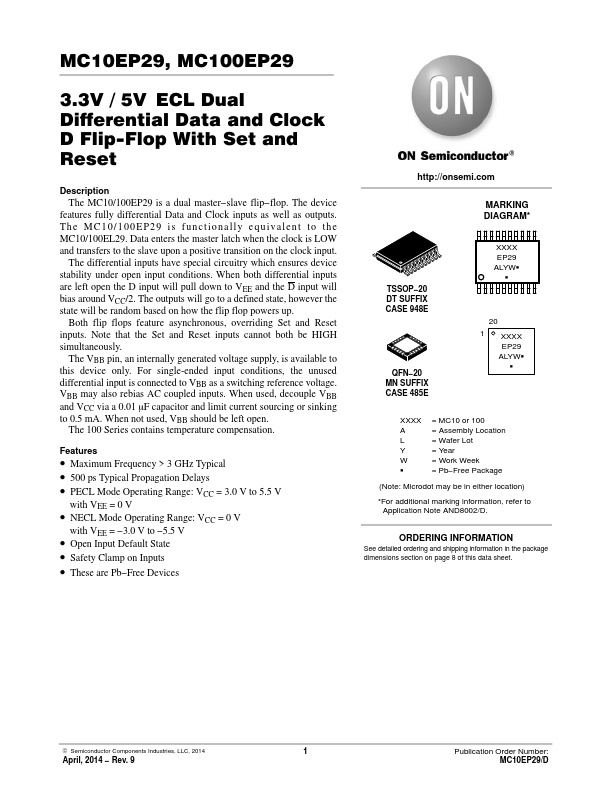
MC10EP29, MC100EP29 3.3V / 5V ECL Dual Differential Data and Clock D Flip-Flop With Set and Reset Description The MC10/100EP29 is a dual master−slave flip−flop. The device features fully differential Data and Clock inputs as well as outputs. The MC10/100EP29 is functionally equivalent to the MC10/100EL29. Data enters the master latch when the clock is LOW and transfers to the slave upon a positive transition on the clock input. The differential inputs have special circuitry which ensures device stability under open input conditions. When both differential inputs are left open the D input will pull down to VEE and the D input will bias around VCC/2. The outputs will go to a defined state, however the state will be random based on how the flip flop powers up.