Datasheet4U Logo Datasheet4U.com

MC75174B - (MC75172B / MC75174B) Quad EIA-485 Line Drivers

Download the MC75174B datasheet PDF. This datasheet also covers the MC75172B variant, as both devices belong to the same (mc75172b / mc75174b) quad eia-485 line drivers family and are provided as variant models within a single manufacturer datasheet.

Key Features

  • include three.
  • state outputs, thermal shutdown, and output current limiting in both directions. These devices also comply with EIA.
  • 422.
  • A, and CCITT Recommendations V.11 and X.27. The MC75172B/174B are optimized for balanced multipoint bus transmission at rates in excess of 10 MBPS. The outputs feature wide common mode voltage range, making them suitable for party line.

📥 Download Datasheet

Note: The manufacturer provides a single datasheet file (MC75172B_ONSemiconductor.pdf) that lists specifications for multiple related part numbers.

Datasheet Details

Part number MC75174B
Manufacturer onsemi
File Size 148.28 KB
Description (MC75172B / MC75174B) Quad EIA-485 Line Drivers
Datasheet download datasheet MC75174B Datasheet

Full PDF Text Transcription (Reference)

The following content is an automatically extracted verbatim text from the original manufacturer datasheet and is provided for reference purposes only.

View original datasheet text
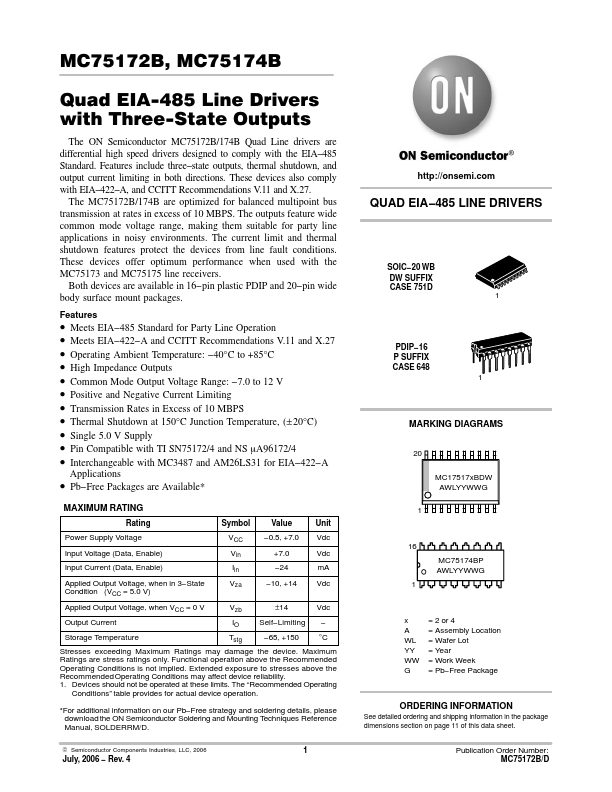
www.DataSheet4U.com MC75172B, MC75174B Quad EIA−485 Line Drivers with Three−State Outputs The ON Semiconductor MC75172B/174B Quad Line drivers are differential high speed drivers designed to comply with the EIA−485 Standard. Features include three−state outputs, thermal shutdown, and output current limiting in both directions. These devices also comply with EIA−422−A, and CCITT Recommendations V.11 and X.27. The MC75172B/174B are optimized for balanced multipoint bus transmission at rates in excess of 10 MBPS. The outputs feature wide common mode voltage range, making them suitable for party line applications in noisy environments. The current limit and thermal shutdown features protect the devices from line fault conditions.