
Datasheet4U Logo Datasheet4U.com

NOIL2SC1300A-GDC - High Speed CMOS Image Sensor

Download the NOIL2SC1300A-GDC datasheet PDF. This datasheet also covers the NOIL2SM1300A variant, as both devices belong to the same high speed cmos image sensor family and are provided as variant models within a single manufacturer datasheet.

General Description

Medical Imaging

Figure 1.

The LUPA1300-2 is an integrated SXGA high speed, high sensitivity CMOS image sensor.
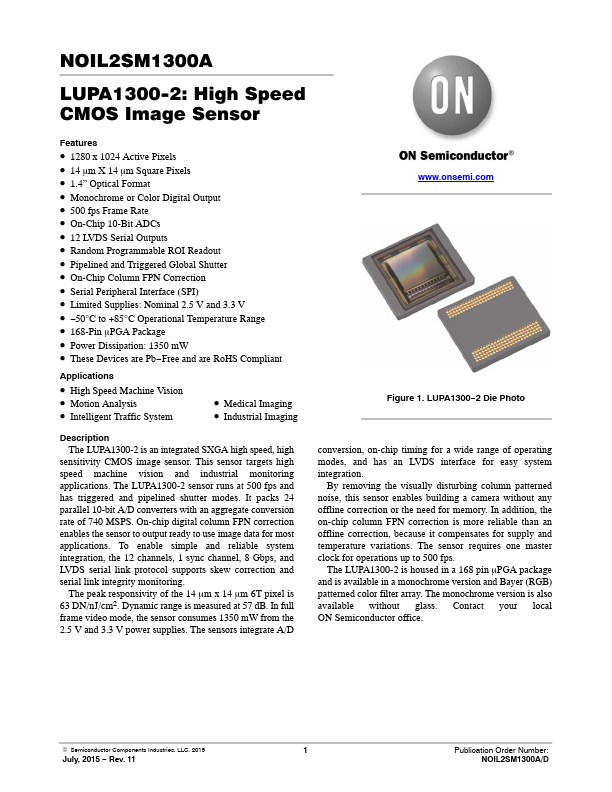
This sensor targets high speed machine vision and industrial monitoring applications.

Key Features

  • 1280 x 1024 Active Pixels 14 mm X 14 mm Square Pixels 1.4” Optical Format Monochrome or Color Digital Output 500 fps Frame Rate On-Chip 10-Bit ADCs 12 LVDS Serial Outputs Random Programmable ROI Readout Pipelined and Triggered Global Shutter On-Chip Column FPN Correction Serial Peripheral Interface (SPI) Limited Supplies: Nominal 2.5 V.

📥 Download Datasheet

Note: The manufacturer provides a single datasheet file (NOIL2SM1300A-ONSemiconductor.pdf) that lists specifications for multiple related part numbers.

Full PDF Text Transcription (Reference)

The following content is an automatically extracted verbatim text from the original manufacturer datasheet and is provided for reference purposes only.

View original datasheet text
NOIL2SM1300A LUPA1300-2: High Speed CMOS Image Sensor Features • • • • • • • • • • • • • • • • 1280 x 1024 Active Pixels 14 mm X 14 mm Square Pixels 1.4” Optical Format Monochrome or Color Digital Output 500 fps Frame Rate On-Chip 10-Bit ADCs 12 LVDS Serial Outputs Random Programmable ROI Readout Pipelined and Triggered Global Shutter On-Chip Column FPN Correction Serial Peripheral Interface (SPI) Limited Supplies: Nominal 2.5 V and 3.3 V −50°C to +85°C Operational Temperature Range 168-Pin mPGA Package Power Dissipation: 1350 mW These Devices are Pb−Free and are RoHS Compliant http://onsemi.com Applications • High Speed Machine Vision • Motion Analysis • Intelligent Traffic System Description • Medical Imaging • Industrial Imaging Figure 1.