Datasheet4U Logo Datasheet4U.com

TPS2399 - -48V Hot Swap Controller

Download the TPS2399 datasheet PDF. This datasheet also covers the TPS2398 variant, as both devices belong to the same -48v hot swap controller family and are provided as variant models within a single manufacturer datasheet.

General Description

Pin Number Pin Name Description 2 EN Enable input to turn on/off power to the load 1 PG Open drain, active

low indication of a load power good condition.

programming of the fault timeout period.

Key Features

  • Wide Input Supply:.
  • 36 V to.
  • 80 V.
  • Transient Rating to.
  • 100 V.
  • Improved Transient Response.
  • Εnable Input (EN).
  • Programmable Current Limit.
  • Programmable Current Slew Rate.
  • Fault Timer to Eliminate Nuisance Trips.
  • Open.
  • Drain Power Good Output (PG).
  • MSOP.
  • 8 Package.
  • These are Pb.
  • Free Devices Typical.

📥 Download Datasheet

Note: The manufacturer provides a single datasheet file (TPS2398-ONSemiconductor.pdf) that lists specifications for multiple related part numbers.

Datasheet Details

Part number TPS2399
Manufacturer onsemi
File Size 660.69 KB
Description -48V Hot Swap Controller
Datasheet download datasheet TPS2399 Datasheet

Full PDF Text Transcription (Reference)

The following content is an automatically extracted verbatim text from the original manufacturer datasheet and is provided for reference purposes only.

View original datasheet text
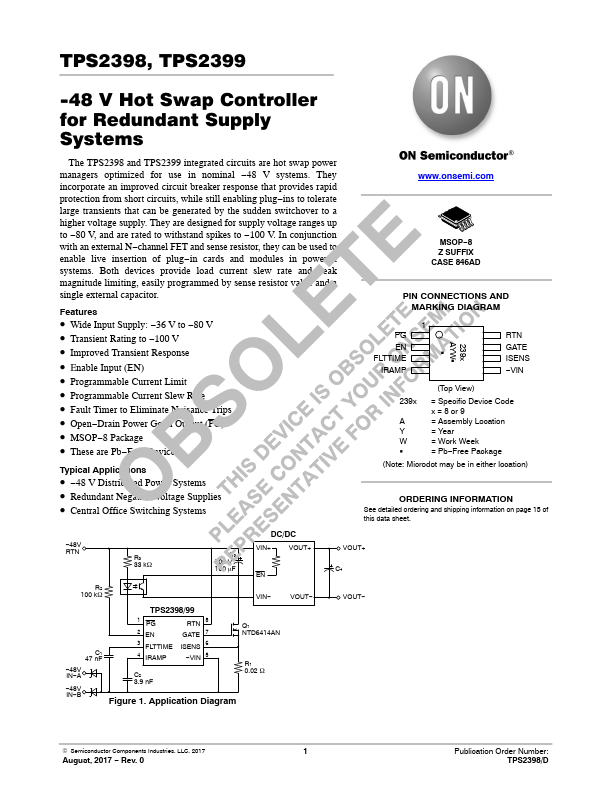
TPS2398, TPS2399 -48 V Hot Swap Controller for Redundant Supply Systems The TPS2398 and TPS2399 integrated circuits are hot swap power managers optimized for use in nominal −48 V systems. They incorporate an improved circuit breaker response that provides rapid protection from short circuits, while still enabling plug−ins to tolerate large transients that can be generated by the sudden switchover to a higher voltage supply. They are designed for supply voltage ranges up to −80 V, and are rated to withstand spikes to −100 V. In conjunction with an external N−channel FET and sense resistor, they can be used to enable live insertion of plug−in cards and modules in powered systems.