Datasheet4U Logo Datasheet4U.com

OHN3151U - Ratiometric Linear Hall-effect Sensor

Download the OHN3151U datasheet PDF. This datasheet also covers the OHN3150U variant, as both devices belong to the same ratiometric linear hall-effect sensor family and are provided as variant models within a single manufacturer datasheet.

General Description

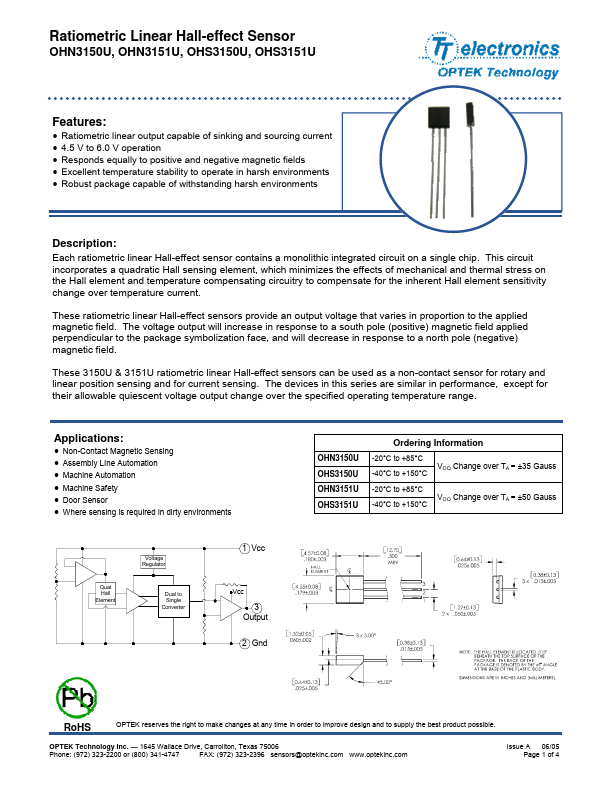
Each ratiometric linear Hall-effect sensor contains a monolithic integrated circuit on a single chip.

Key Features

  • Ratiometric linear output capable of sinking and sourcing current.
  • 4.5 V to 6.0 V operation.
  • Responds equally to positive and negative magnetic fields.
  • Excellent temperature stability to operate in harsh environments.
  • Robust package capable of withstanding harsh environments Product Photo Here.

📥 Download Datasheet

Note: The manufacturer provides a single datasheet file (OHN3150U-OPTEKTechnologies.pdf) that lists specifications for multiple related part numbers.

Datasheet Details

Part number OHN3151U
Manufacturer OPTEK Technologies
File Size 576.73 KB
Description Ratiometric Linear Hall-effect Sensor
Datasheet download datasheet OHN3151U Datasheet

Full PDF Text Transcription (Reference)

The following content is an automatically extracted verbatim text from the original manufacturer datasheet and is provided for reference purposes only.

View original datasheet text
Ratiometric Linear Hall-effect Sensor OHN3150U, OHN3151U, OHS3150U, OHS3151U Features: • Ratiometric linear output capable of sinking and sourcing current • 4.5 V to 6.0 V operation • Responds equally to positive and negative magnetic fields • Excellent temperature stability to operate in harsh environments • Robust package capable of withstanding harsh environments Product Photo Here Description: Each ratiometric linear Hall-effect sensor contains a monolithic integrated circuit on a single chip. This circuit incorporates a quadratic Hall sensing element, which minimizes the effects of mechanical and thermal stress on the Hall element and temperature compensating circuitry to compensate for the inherent Hall element sensitivity change over temperature current.