UF606G
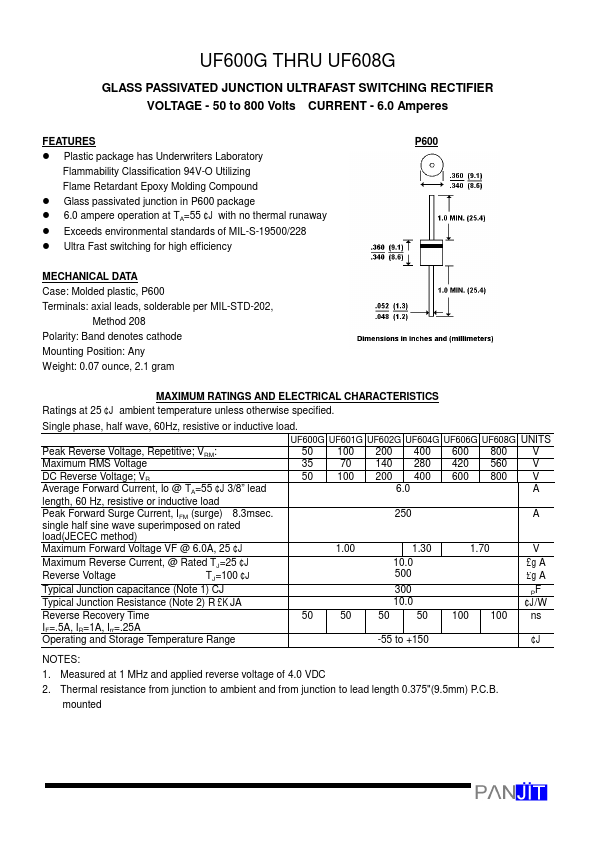
UF606G is GLASS PASSIVATED JUNCTION ULTRAFAST SWITCHING RECTIFIER manufactured by PanJit Semiconductor.
- Part of the UF600G comparator family.
- Part of the UF600G comparator family.
FEATURES l Plastic package has Underwriters Laboratory Flammability Classification 94V-O Utilizing Flame Retardant Epoxy Molding pound l Glass passivated junction in P600 package l 6.0 ampere operation at TA=55 ¢J with no thermal runaway l l Exceeds environmental standards of MIL-S-19500/228 Ultra Fast switching for high efficiency P600
MECHANICAL DATA Case: Molded plastic, P600 Terminals: axial leads, solderable per MIL-STD-202, Method 208 Polarity: Band denotes cathode Mounting Position: Any Weight: 0.07 ounce, 2.1 gram MAXIMUM RATINGS AND ELECTRICAL CHARACTERISTICS Ratings at 25 ¢J ambient temperature unless otherwise specified. Single phase, half wave, 60Hz, resistive or inductive load.
UF600G UF601G UF602G UF604G UF606G UF608G UNITS
Peak Reverse Voltage, Repetitive; VRM: Maximum RMS Voltage DC Reverse Voltage; VR Average Forward Current, Io @ TA=55 ¢J 3/8” lead length, 60 Hz, resistive or inductive load Peak Forward Surge Current, IFM (surge) 8.3msec. single half sine wave superimposed on rated load(JECEC method) Maximum Forward Voltage VF @ 6.0A, 25 ¢J Maximum Reverse Current, @ Rated TJ=25 ¢J Reverse Voltage TJ=100 ¢J Typical Junction capacitance (Note 1) CJ Typical Junction Resistance (Note 2) R £K JA Reverse Recovery Time IF=.5A, IR=1A, Irr=.25A Operating and Storage Temperature Range
50 35 50
100 70 100
200 140 200 6.0 250
400 280 400
600 420 600
800 560 800
V V V A A
1.30 10.0 500 300 10.0
V £g A £g A PF ¢J /W ns ¢J
-55 to +150
NOTES: 1. Measured at 1 MHz and applied reverse voltage of 4.0 VDC 2. Thermal resistance from junction to ambient and from junction to lead length 0.375"(9.5mm) P.C.B. mounted
RATING AND CHARACTERISTIC CURVES UF600G THRU UF608G trr
+0.5A 0 -0.25
NOTE:1.Rise Time = 7ns max. Input Impedance = 1 megohm. 22p F 2.Rise Time = 10ns max. Source Impedance = 50 Ohms
-1.0
SET TIME BASE FOR 50 ns/cm
1cm
Fig. 1-REVERSE RECOVERY TIME CHARACTERISTIC AND TEST CIRCUIT DIAGRAM
AVERAGE...