EKMA
EKMA is Motion Sensor manufactured by Panasonic.
Security & Wireless Devices
- Security sensors and cameras
- Wireless occupancy sensors driven by photovoltaic cells or battery to extend battery life.
Housing & mercial equipment
- Lighting fixtures and wiring devices
- Video inters, HA control panels
- Vending machines etc.
Home appliances ( Energy savings)
- Television and PC monitors
- PC, Air-Conditioners
- Air Purifiers
- Wireless and Battery operated monitoring sensing devices
1. Low profile achieved with fitted lens and embedded sensing circuit.
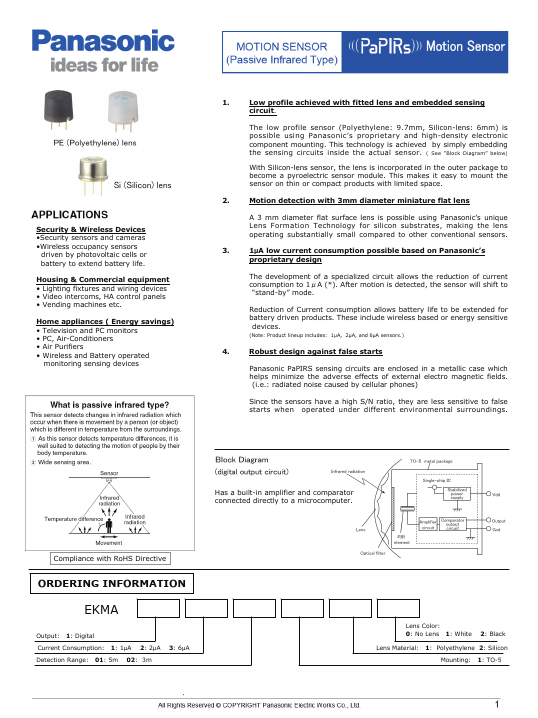
The low profile sensor (Polyethylene: 9.7mm, Silicon-lens: 6mm) is possible using Panasonic’s proprietary and high-density electronic ponent mounting. This technology is achieved by simply embedding the sensing circuits inside the actual sensor. ( See “Block Diagram” below)
With Silicon-lens sensor, the lens is incorporated in the outer package to bee a pyroelectric sensor module. This makes it easy to mount the sensor on thin or pact products with limited space.
2. Motion detection with 3mm diameter miniature flat lens
A 3 mm diameter flat surface lens is possible using Panasonic’s unique Lens Formation Technology for silicon substrates, making the lens operating substantially small pared to other conventional sensors.
3. 1μA low current consumption possible based on Panasonic’s proprietary design
The development of a specialized circuit allows the reduction of current consumption to 1μA (- ). After motion is detected, the sensor will shift to “stand-by” mode.
Reduction of Current consumption allows battery life to be extended for battery driven products. These include wireless based or energy sensitive devices.
(Note: Product lineup includes: 1μA, 2μA, and 6μA sensors.)
4. Robust design against false starts
Panasonic Pa PIRS sensing circuits are enclosed in a metallic case which helps minimize the adverse effects of external electro magnetic fields. (i.e.: radiated noise caused by cellular phones)
Since the sensors have a high S/N ratio, they are less sensitive to...