PI74ALVCH16374
PI74ALVCH16374 is 16-Bit Edge Triggered D-Type Flip-Flop manufactured by Pericom Semiconductor.
12345678901234567890123456789012123456789012345678901234567890121234567890123456789012345678901212345678901234567890123456789012123456789012 12345678901234567890123456789012123456789012345678901234567890121234567890123456789012345678901212345678901234567890123456789012123456789012 12345678901234567890123456789012123456789012345678901234567890121234567890123456789012345678901212345678901234567890123456789012123456789012
16-Bit Edge Triggered D-Type Flip-Flop with 3-State Outputs
Product Features
PI74ALVCH16374 is designed for low voltage operation VCC = 2.3V to 3.6V Hysteresis on all inputs Typical VOLP (Output Ground Bounce) < 0.8V at V = 3.3V, TA = 25°C .. CC
- Typical VOHV (Output VOH Undershoot) < 2.0V at VCC = 3.3V, TA = 25°C
- Bus Hold retains last active bus state during 3-STATE eliminating the need for external pullup resistors
- Industrial operation at 40°C to +85°C
- Packages available: 48-pin 240 mil wide plastic TSSOP (A) 48-pin 300 mil wide plastic SSOP (V)
- -
- -
Product Description
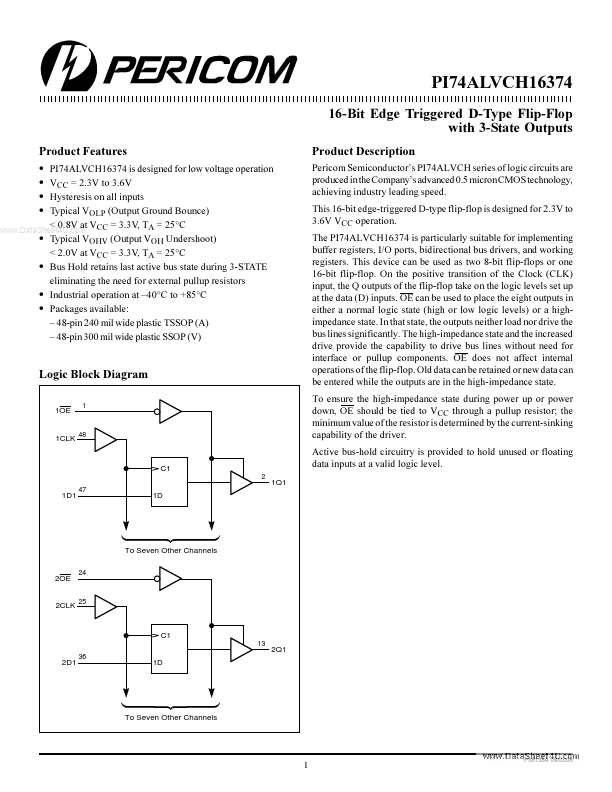
Peri Semiconductors PI74ALVCH series of logic circuits are produced in the panys advanced 0.5 micron CMOS technology, achieving industry leading speed. This 16-bit edge-triggered D-type flip-flop is designed for 2.3V to 3.6V VCC operation. The PI74ALVCH16374 is particularly suitable for implementing buffer registers, I/O ports, bidirectional bus drivers, and working registers. This device can be used as two 8-bit flip-flops or one 16-bit flip-flop. On the positive transition of the Clock (CLK) input, the Q outputs of the flip-flop take on the logic levels set up at the data (D) inputs. OE can be used to place the eight outputs in either a normal logic state (high or low logic levels) or a highimpedance state. In that state, the outputs neither load nor drive the bus lines significantly. The high-impedance state and the increased drive provide the capability to drive bus lines without need for interface or pullup ponents....