PI74FCT162H240T
PI74FCT162H240T is Fast CMOS 16-Bit Buffer /Line Drivers manufactured by Pericom Semiconductor.
Features
: mon Features
:
- PI74FCT16240T, PI74FCT162240T, and PI74FCT162H240T are high-speed, low power devices with high current drive
- VCC = 5 V ±10%
- Hysteresis on all inputs
- Packages available:
- 48-pin 240 mil wide plastic TSSOP (A)
- 48-pin 300 mil wide plastic SSOP (V) PI74FCT16240T Features
:
- High output drive: IOH =
- 32 m A; IOL = 64 m A
- Power off disable outputs permit "live insertion"
- Typical VOLP (Output Ground Bounce) < 1.0V at VCC = 5V, TA = 25°C PI74FCT162240T Features
:
- Balanced output drivers: ±24 m A
- Reduced system switching noise
- Typical VOLP (Output Ground Bounce) < 0.6V at VCC = 5V, TA = 25°C PI74FCT162H240T Features
:
- Bus Hold retains last active bus state during 3-state
- Eliminates the need for external pull-up resistors
Fast CMOS 16-Bit Buffer/Line Drivers
Product Description
:
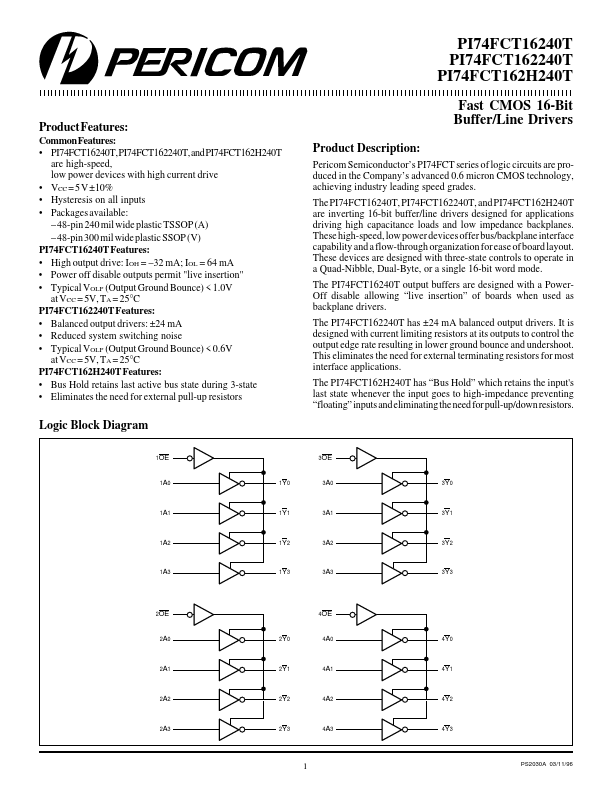
Peri Semiconductor’s PI74FCT series of logic circuits are produced in the pany’s advanced 0.6 micron CMOS technology, achieving industry leading speed grades. The PI74FCT16240T, PI74FCT162240T, and PI74FCT162H240T are inverting 16-bit buffer/line drivers designed for applications driving high capacitance loads and low impedance backplanes. These high-speed, low power devices offer bus/backplane interface capability and a flow-through organization for ease of board layout. These devices are designed with three-state controls to operate in a Quad-Nibble, Dual-Byte, or a single 16-bit word mode. The PI74FCT16240T output buffers are designed with a Power Off disable allowing “live insertion” of boards when used as backplane drivers. The PI74FCT162240T has ±24 m A balanced output drivers. It is designed with current limiting resistors at its outputs to control the output edge rate resulting in lower ground bounce and undershoot. This eliminates the need for external terminating resistors for most interface applications. The PI74FCT162H240T has “Bus Hold” which retains the input's last state whenever the input goes to high-impedance preventing “floating” inputs...