PS396
PS396 is Precision / 16-Channel 17V Analog Multiplexer manufactured by Pericom Semiconductor.
Features
- Low ON-Resistance (100 Ohms Max.) Minimizes Distortion and Error Voltages
- Low Glitching Reduces Step Errors and Improves Settling Times. Charge Injection: 5p C Max.
- Dual-Supply Operation (±2.7V to ±8V)
- Single-Supply Operation (+2.7V to +16V)
- ON-Resistance Matching Between Channels: <6 Ohms
- ON-Resistance Flatness: 10 Ohms (Max.)
- TTL/CMOS Logic patible (with +5V or ±5V supplies)
- Fast Switching Speed, t TRANS <250ns
- Break-Before-Make action eliminates momentary crosstalk
- Rail-to-Rail Analog Signal Range
- Low Power Consumption, 10µW
- Pin patible with MAX396
- SOIC and SSOP Packages Minimize Board Area
Description
The PS396 low-voltage, CMOS analog multiplexer offers low ONresistance (100 ohms max.), which is matched to within 6 ohms between switches and remains flat over the specified signal range (10 ohms max). The PS396 is a 16-channel device. The PS396 are fabricated using Peri’s 17V silicon gate process. Design improvements yield extremely low charge injection (5p C max). This multiplexer operates with a single +2.7V to +16V supply or with ±2.7V to ±8V dual supplies, while retaining CMOS-logic input patibility and fast switching. The PS396 is pin patible with the MAX396.
Applications
- -
- -
- - Data Acquisition Systems Audio Switching and Routing Test Equipment PBX, PABX Telemunication Systems Battery-Powered Systems
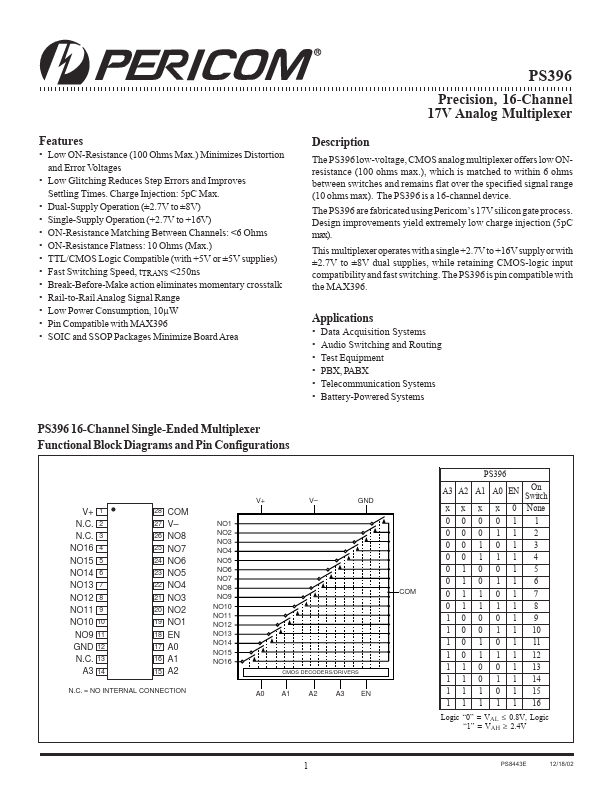
PS396 16-Channel Single-Ended Multiplexer Functional Block Diagrams and Pin Configurations
P S 396 A3 A2 A1 A0 EN
V+ V- GND
V+ N.C. N.C. NO16 NO15 NO14 NO13 NO12 NO11 NO10 NO9 GND N.C. A3
1 2 3 4 5 6 7 8 9 10 11 12 13 14
28 27 26 25 24 23 22 21 20 19 18 17 16 15
V- NO8 NO7 NO6 NO5 NO4 NO3 NO2 NO1 EN A0 A1 A2
NO1 NO2 NO3 NO4 NO5 NO6 NO7 NO8 NO9 NO10 NO11 NO12 NO13 NO14 NO15 NO16
CMOS DECODERS/DRIVERS
N.C. = NO INTERNAL CONNECTION
A0
A1
A2
A3
EN x 0 0 0 0 0 0 0 0 1 1 1 1 1 1 1 1 x 0 0 0 0 1 1 1 1 0 0 0 0 1 1 1 1 x 0 0 1 1 0 0 1 1 0 0 1 1 0 0 1 1 x 0 1 0 1 0 1 0 1 0 1 0 1 0 1 0 1
0 1 1 1 1 1 1 1 1 1 1 1 1...