PI5USB30216D
PI5USB30216D is Plug-in Detector manufactured by Pericom Semiconductor.
Features
- patible to USB Type-C™ Specification 1.1
- Backward patible to USB Type-C Specification 1.0
- Supports Host mode/Device mode/Dual-role mode
- Supports Dual-role modes with/without Try.SNK/Try.SRC s u p p o rted
- Auto-configure ports orientation through CC detection
- Supports both pin control and I2C interface for control and munication
- Integrated high-precision resistors and current sources for
CC pins
- Provides support for Default current, 1.5A and 3A modes with I2C control
- Power saving mode
- Output indicator for plug-in detection
- Wide power supply range : 2.7V
- 5.5V
- Industrial Temperature Range: -40o C to 85o C
- Packaging (Pb-free & Green):
- 12- contact, STQFN(1.6mm x1.6mm)
Applications
- Notebooks
- Mobile Phones
- Tablets
- Docking Station
Pin Configuration
Description
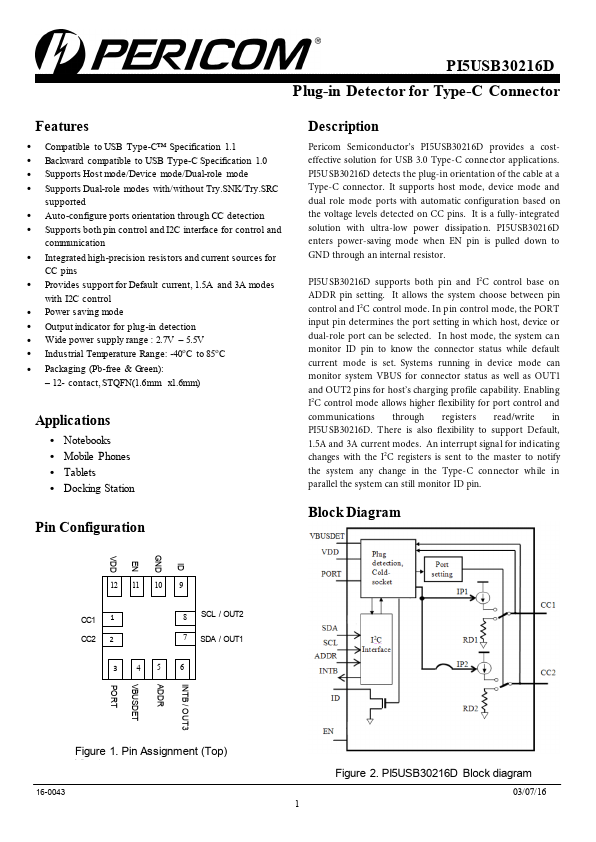
Peri Semiconductor’s PI5USB30216D provides a costeffective solution for USB 3.0 Type-C conne ctor applications. PI5U SB30216D detects the plug-in orientation of the cable at a Type-C connector. It supports host mode, device mode and dual role mode ports with automatic configuration based on the voltage levels detected on CC pins. It is a fully- integrated solution with ultra-low power dissipatio n. PI5USB30216D enters power-saving mode when EN pin is pulled down to GND through an internal resistor.
PI5U SB30216D supports both pin and I2C control base on ADDR pin setting. It allows the system choose between pin control and I2C control mode. In pin control mode, the PORT input pin determines the port setting in which host, device or dual-role port can be selected. In host mode, the system can monitor ID pin to know the connector status while default current mode is set. Systems running in device mode can monitor system VBUS for connector status as well as OUT1 and OUT2 pins for host’s charging profile capability. Enabling I2C control mode allows higher flexibility for port control and munications through registers read/write in PI5U SB30216D. There is also flexibility to...