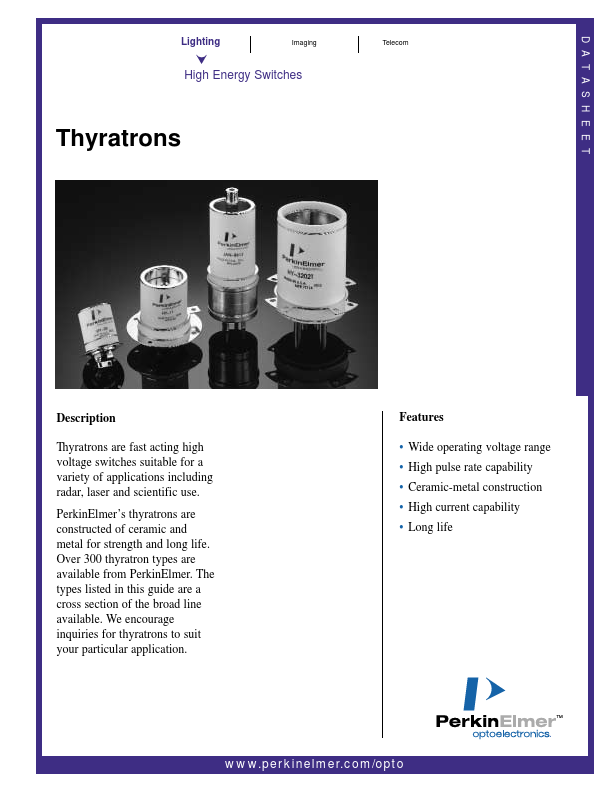
LS-4111
Key Features
- Wide operating voltage range
- High pulse rate capability
- Ceramic-metal construction
- High current capability
- Long life . How a Thyratron works The operation of the device can be divided into three phases: triggering and commutation (closure), steady-state conduction, and recovery (opening), each of which is discussed below. The commutation process is simply modeled as shown in Figure
- The time interval between trigger breakdown of the grid-cathode region and complete closure of the thyratron is called the anode delay time. It is typically 100-200 nanoseconds for most tube types. During commutation, a high voltage spike appears at the grid of the thyratron. This spike happens in the time it takes for the plasma in the grid-anode space to "connect" to the plasma in the gridcathode space. During this time, the anode is momentarily "connected" to the grid thereby causing the grid to assume a voltage nearly that of the anode’s. Although the grid spike voltage is brief in duration, usually less than 100 nS, it can damage the grid driver circuit unless measures are taken to suppress the spike before it enters the grid driver circuit. The location of the grid spike suppression circuit is shown in Figure 3, Grid Circuit. Figure 4, Typical Grid Spike Suppression Circuits, shows the more common methods used to protect the grid driver circuit. In using any of these types of circuits, care must be ex