Philips 74F194
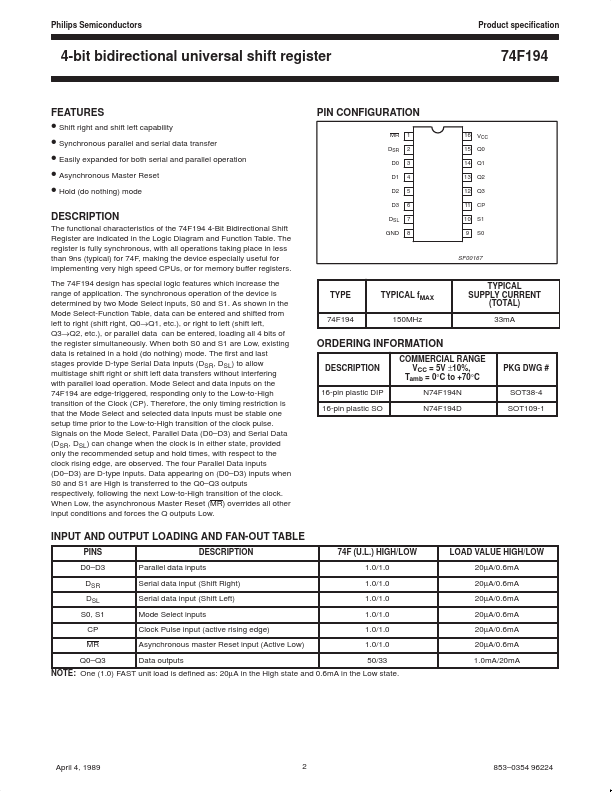
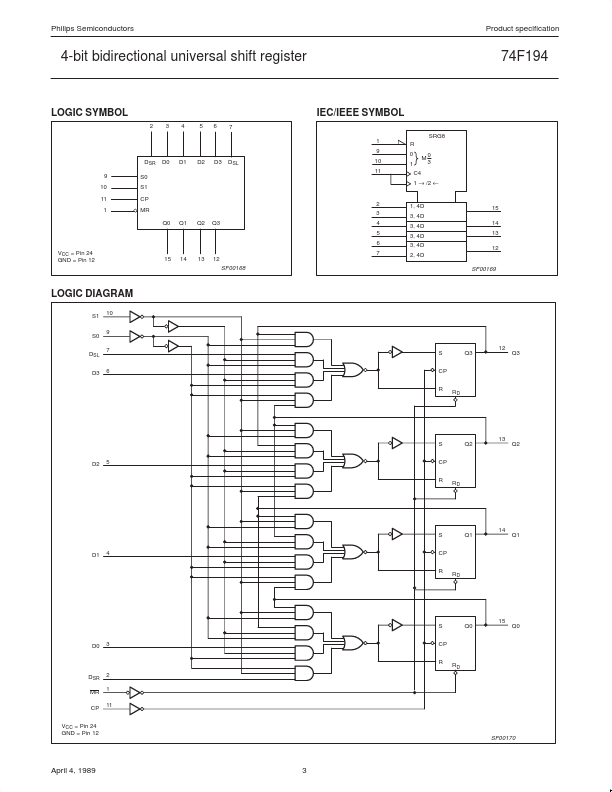
the 74F194 4-Bit Bidirectional Shift Register are indicated in the Logic Diagram and Function Table. The register is fully synchronous, with all operations taking place in less than 9ns (typical) for 74F, making the device especially useful for implementing very high speed CPUs, or for memory buffer registers. The 74F194 design has special logic features which increase the range of application.| Part No. | 74F194 |
|---|---|
| Datasheet | 74F194 Download |
| Manufacturer |  Philips |
| Description | 4-bit bidirectional universal shift register |
| Buy | Stock & Price |
FEATURES
● Shift right and shift left capability● Synchronous parallel and serial data transfer
● Easily expanded for both serial and parallel operation
● Asynchronous Master Reset
● Hold (do nothing) mode
DESCRIPTION
The functional characteristics of The synchronous operation of the device is determined by two Mode Select inputs, S0 and S1. As shown in the Mode Select-Function Table, data can be entered and shifted from left to right (shift right, Q0→Q1, etc.), or right to left (shift left, Q3→Q2, etc.), or parallel data can be entered, loading all 4 bits of the register simultaneously. When both S0 and S1 are Low, existing data is retained in a hold (do nothing) mode. The first and last stages provide D-type Serial Data inputs (DSR, DSL) to allow multistage shift right or shift left data transfers without interfering with parallel load operation. Mode Select and data inputs on the 74F194 are edge-triggered, responding only to the Low-to-High transition of the Clock (CP). Therefore,...