74F835
74F835 is 8-bit shift register manufactured by Philips Semiconductors.
FEATURES
- Specifically designed for Video applications
- bines the 74F373, two 74F157s, and the 74F166 functions in
- Interleaved loading with 2:1 mux
- Dual 8-bit parallel inputs
- Transparent latch on all “B” inputs
- Guaranteed serial shift frequency to 100MHz
- Expandable to 16-bits or more with serial input
DESCRIPTION
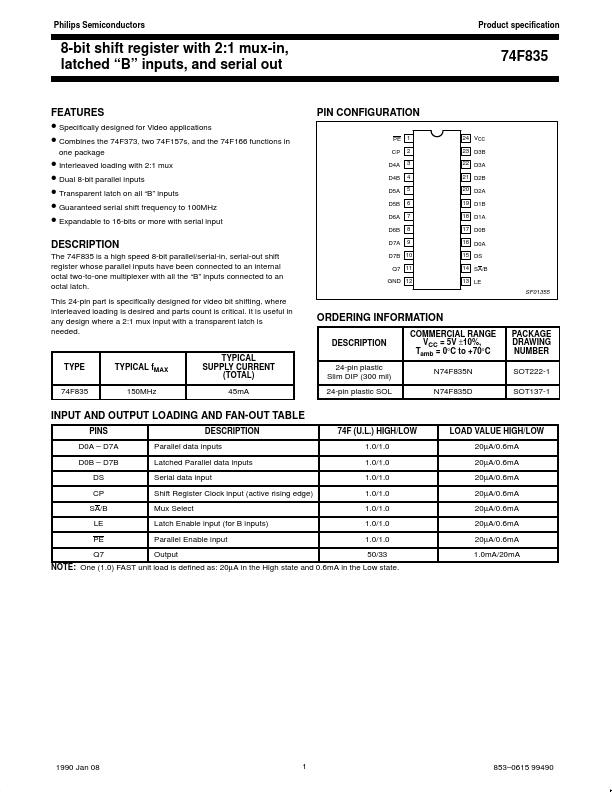
The 74F835 is a high speed 8-bit parallel/serial-in, serial-out shift register whose parallel inputs have been connected to an internal octal two-to-one multiplexer with all the “B” inputs connected to an octal latch. This 24-pin part is specifically designed for video bit shifting, where interleaved loading is desired and parts count is critical. It is useful in any design where a 2:1 mux input with a transparent latch is needed. TYPICAL SUPPLY CURRENT (TOTAL) 45m A one package
PIN CONFIGURATION
PE 1 CP D4A D4B D5A D5B D6A D6B D7A 2 3 4 5 6 7 8 9 24 VCC 23 D3B 22 D3A 21 D2B 20 D2A 19 D1B 18 D1A 17 D0B 16 D0A 15 DS 14 SA/B 13 LE
D7B 10 Q7 11 GND 12
SF01355
ORDERING INFORMATION
DESCRIPTION
MERCIAL RANGE VCC = 5V ±10%, Tamb = 0°C to +70°C N74F835N N74F835D PACKAGE DRAWING NUMBER SOT222-1 SOT137-1
TYPE 74F835
TYPICAL f MAX 150MHz
24-pin plastic Slim DIP (300 mil) 24-pin plastic SOL
INPUT AND OUTPUT LOADING AND FAN-OUT TABLE
PINS D0A
- D7A D0B
- D7B DS CP SA/B LE PE Q7 DESCRIPTION
Parallel data inputs Latched Parallel data inputs Serial data input Shift Register Clock input (active rising edge) Mux Select Latch Enable input (for B inputs) Parallel Enable input Output 74F (U.L.) HIGH/LOW 1.0/1.0 1.0/1.0 1.0/1.0 1.0/1.0 1.0/1.0 1.0/1.0 1.0/1.0 50/33 LOAD VALUE HIGH/LOW 20µA/0.6m A 20µA/0.6m A 20µA/0.6m A 20µA/0.6m A 20µA/0.6m A 20µA/0.6m A 20µA/0.6m A 1.0m A/20m A
NOTE: One (1.0) FAST unit load is defined as: 20µA in the High state and 0.6m A in the Low state.
1990 Jan 08
853- 0615 99490
Philips Semiconductors
Product specification
8-bit shift register with 2:1 mux-in, latched “B” inputs, and serial out
LOGIC SYMBOL
IEC/IEEE SYMBOL
2...