• Part: AN241
  • Description: Thermal Considerations
  • Manufacturer: Philips Semiconductors
  • Size: 121.83 KB
Download AN241 Datasheet PDF
Philips Semiconductors
AN241
AN241 is Thermal Considerations manufactured by Philips Semiconductors.
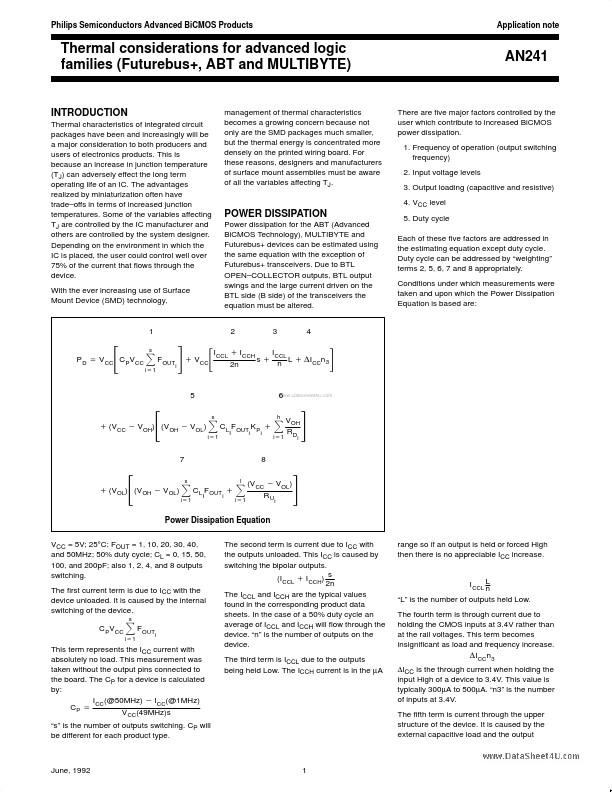
Philips Semiconductors Advanced Bi CMOS Products Application note Thermal considerations for advanced logic families (Futurebus+, ABT and MULTIBYTE) INTRODUCTION Thermal characteristics of integrated circuit packages have been and increasingly will be a major consideration to both producers and users of electronics products. This is because an increase in junction temperature (TJ) can adversely effect the long term operating life of an IC. The advantages realized by miniaturization often have trade- offs in terms of increased junction temperatures. Some of the variables affecting TJ are controlled by the IC manufacturer and others are controlled by the system designer. Depending on the environment in which the IC is placed, the user could control well over 75% of the current that flows through the device. With the ever increasing use of Surface Mount Device (SMD) technology, management of thermal characteristics bees a growing concern because not only are the SMD packages much smaller, but the thermal energy is concentrated more densely on the printed wiring board. For these reasons, designers and manufacturers of surface mount assemblies must be aware of all the variables affecting TJ. There are five major factors controlled by the user which contribute to increased Bi CMOS power dissipation. 1. Frequency of operation (output switching frequency) 2. Input voltage levels 3. Output loading (capacitive and resistive) 4. VCC level POWER DISSIPATION Power dissipation for the ABT (Advanced Bi CMOS Technology), MULTIBYTE and Futurebus+ devices can be estimated using the same equation with the exception of Futurebus+ transceivers. Due to BTL OPEN- COLLECTOR outputs, BTL output swings and the large current driven on the BTL side (B side) of the transceivers the equation must be altered. 2 3 4 5. Duty cycle Each of these five factors are addressed in the estimating equation except duty cycle. Duty cycle can be addressed by “weighting” terms 2, 5, 6, 7 and 8...