NE4558
NE4558 is Dual general-purpose operational amplifier manufactured by Philips Semiconductors.
DESCRIPTION
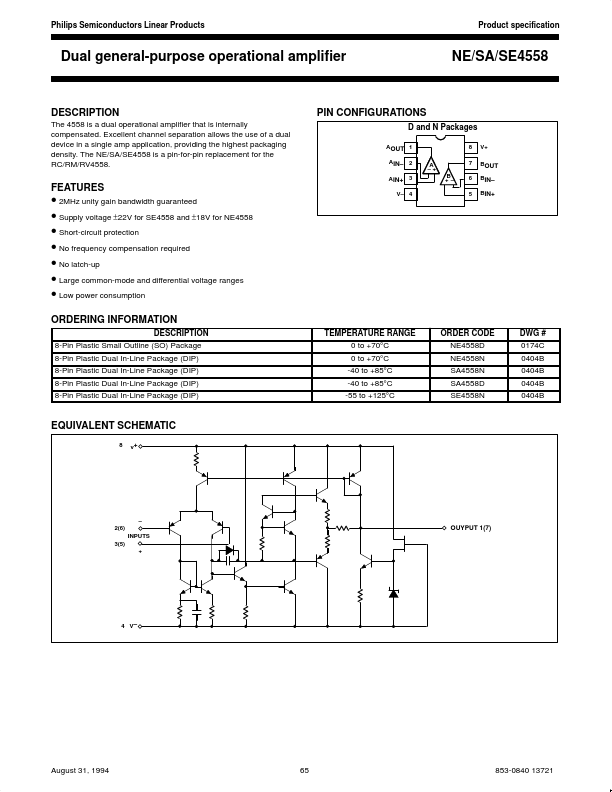
The 4558 is a dual operational amplifier that is internally pensated. Excellent channel separation allows the use of a dual device in a single amp application, providing the highest packaging density. The NE/SA/SE4558 is a pin-for-pin replacement for the RC/RM/RV4558.
PIN CONFIGURATIONS
D and N Packages
AOUT 1 AIN- 2 AIN+ 3 V- 4 A
- + B +- 8 7 6 5 V+ BOUT BIN- BIN+
FEATURES
- 2MHz unity gain bandwidth guaranteed
- Supply voltage ±22V for SE4558 and ±18V for NE4558
- Short-circuit protection
- No frequency pensation required
- No latch-up
- Large mon-mode and differential voltage ranges
- Low power consumption
ORDERING INFORMATION
DESCRIPTION
8-Pin Plastic Small Outline (SO) Package 8-Pin Plastic Dual In-Line Package (DIP) 8-Pin Plastic Dual In-Line Package (DIP) 8-Pin Plastic Dual In-Line Package (DIP) 8-Pin Plastic Dual In-Line Package (DIP)
TEMPERATURE RANGE 0 to +70°C 0 to +70°C -40 to +85°C -40 to +85°C -55 to +125°C
ORDER CODE NE4558D NE4558N SA4558N SA4558D SE4558N
DWG # 0174C 0404B 0404B 0404B 0404B
EQUIVALENT SCHEMATIC
8 v+
- 2(6) INPUTS 3(5) +
OUYPUT 1(7)
4 V-
August 31, 1994
853-0840 13721
Philips Semiconductors Linear Products
Product specification
Dual general-purpose operational amplifier
NE/SA/SE4558
ABSOLUTE MAXIMUM RATINGS
SYMBOL VCC Supply voltage SE4558 NE4558, SA4558 PD MAX Maximum power dissipation, TA=25°C (Still air)1 N package D package Differential input voltage VIN TSTG TA Input voltage2 Storage temperature range Operating ambient temperature range SE4558 SA4558 NE4558 TSOLD Lead soldering temperature (10sec max) Output short-circuit duration3 -55 to +125 -40 to +85 0 to +70 300 Indefinite °C °C °C °C 1160 780 ±30 ±15 -65 to +150 m W m W V V °C ±22 ±18 V V PARAMETER RATING UNIT
NOTES: 1. Derate above 25°C at the following rates: N package at 9.3m W/°C D package at 6.2m W/°C 2. For supply voltages less than ±15V, the absolute maximum input voltage is equal to the supply voltage. 3. Short-circuit may be to ground...