SA5521N
SA5521N is LVDT signal conditioner manufactured by Philips Semiconductors.
DESCRIPTION
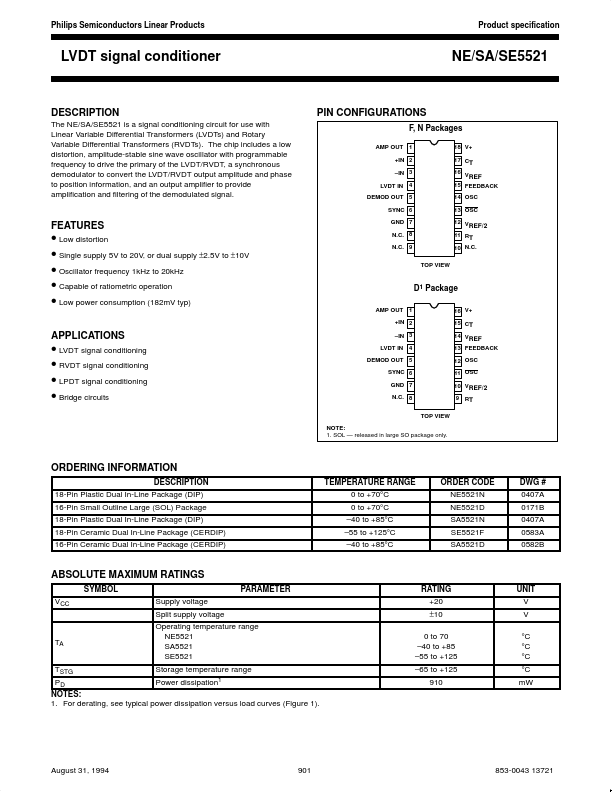
The NE/SA/SE5521 is a signal conditioning circuit for use with Linear Variable Differential Transformers (LVDTs) and Rotary Variable Differential Transformers (RVDTs). The chip includes a low distortion, amplitude-stable sine wave oscillator with programmable frequency to drive the primary of the LVDT/RVDT, a synchronous demodulator to convert the LVDT/RVDT output amplitude and phase to position information, and an output amplifier to provide amplification and filtering of the demodulated signal.
PIN CONFIGURATIONS
F, N Packages
AMP OUT 1 +IN 2
- IN 3 LVDT IN 4 DEMOD OUT 5 SYNC 6 18 V+ 17 C T 16 V REF 15 FEEDBACK 14 OSC 13 OSC 12 V REF/2 11 R T 10 N.C. TOP VIEW
FEATURES
GND 7 N.C. 8 N.C. 9
- Low distortion
- Single supply 5V to 20V, or dual supply ±2.5V to ±10V
- Oscillator frequency 1k Hz to 20k Hz
- Capable of ratiometric operation
- Low power consumption (182m V typ)
APPLICATIONS
D1 Package
AMP OUT 1 +IN 2
- IN 3 LVDT IN 4 DEMOD OUT 5 SYNC 6 GND 7 N.C. 8 TOP VIEW NOTE: 1. SOL
- released in large SO package only. 16 V+ 15 CT 14 V REF 13 FEEDBACK 12 OSC 11 OSC 10 VREF/2 9 RT
- LVDT signal conditioning
- RVDT signal conditioning
- LPDT signal conditioning
- Bridge circuits
ORDERING INFORMATION
DESCRIPTION
18-Pin Plastic Dual In-Line Package (DIP) 16-Pin Small Outline Large (SOL) Package 18-Pin Plastic Dual In-Line Package (DIP) 18-Pin Ceramic Dual In-Line Package (CERDIP) 16-Pin Ceramic Dual In-Line Package (CERDIP) TEMPERATURE RANGE 0 to +70°C 0 to +70°C
- 40 to +85°C
- 55 to +125°C
- 40 to +85°C ORDER CODE NE5521N NE5521D SA5521N SE5521F SA5521D DWG # 0407A 0171B 0407A 0583A 0582B
ABSOLUTE MAXIMUM RATINGS
SYMBOL VCC Supply voltage Split supply voltage Operating temperature range NE5521 SA5521 SE5521 Storage temperature range Power dissipation1 PARAMETER RATING +20 ±10 0 to 70
- 40 to +85
- 55 to +125
- 65 to +125 910 UNIT V V °C °C °C °C m W
TA TSTG PD
NOTES: 1. For derating, see typical power dissipation versus load curves (Figure 1).
August 31,...