TISP4165H4BJ
TISP4165H4BJ is BIDIRECTIONAL THYRISTOR OVERVOLTAGE PROTECTORS manufactured by Power Innovations Limited.
TISP4165H4BJ THRU TISP4200H4BJ, TISP4265H4BJ THRU TISP4360H4BJ BIDIRECTIONAL THYRISTOR OVERVOLTAGE PROTECTORS
Copyright © 1999, Power Innovations Limited, UK NOVEMBER 1997
- REVISED MARCH 1999
HIGH HOLDING CURRENT 100 A 10/1000 OVERVOLTAGE PROTECTORS q q q
8 k V 10/700, 200 A 5/310 ITU-T K20/21 rating High Holding Current
- . . . . 225 m A min. Ion-Implanted Breakdown Region Precise and Stable Voltage Low Voltage Overshoot under Surge
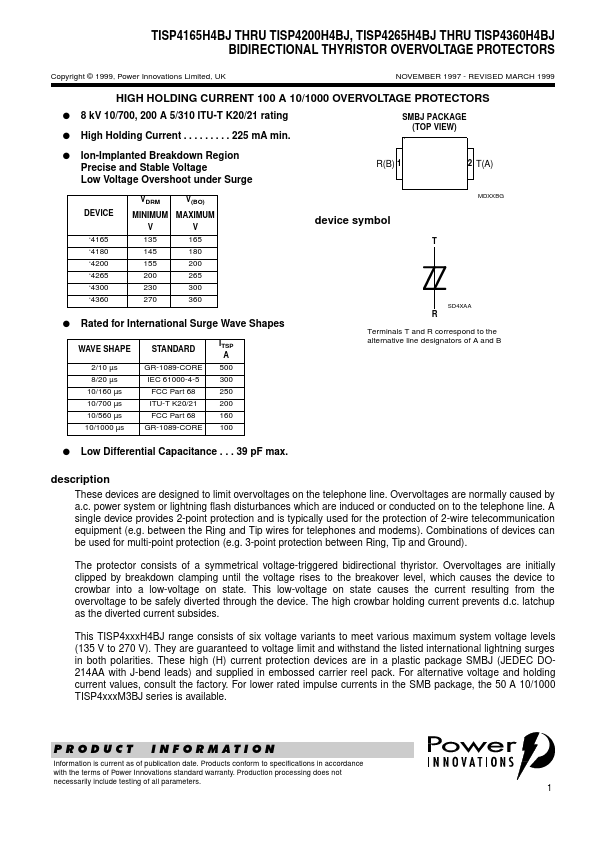
VDRM DEVICE ‘4165 ‘4180 ‘4200 ‘4265 ‘4300 ‘4360 V 135 145 155 200 230 270 V(BO) V 165 180 200 265 300 360
SMBJ PACKAGE (TOP VIEW)
R(B) 1
2 T(A)
MDXXBG
MINIMUM MAXIMUM device symbol
SD4XAA
R q
Rated for International Surge Wave Shapes
WAVE SHAPE 2/10 µs 8/20 µs 10/160 µs 10/700 µs 10/560 µs 10/1000 µs STANDARD GR-1089-CORE IEC 61000-4-5 FCC Part 68 ITU-T K20/21 FCC Part 68 GR-1089-CORE ITSP A 500 300 250 200 160 100
Terminals T and R correspond to the alternative line designators of A and B q
Low Differential Capacitance . . . 39 p F max. description
These devices are designed to limit overvoltages on the telephone line. Overvoltages are normally caused by a.c. power system or lightning flash disturbances which are induced or conducted on to the telephone line. A single device provides 2-point protection and is typically used for the protection of 2-wire telemunication equipment (e.g. between the Ring and Tip wires for telephones and modems). binations of devices can be used for multi-point protection (e.g. 3-point protection between Ring, Tip and Ground). The protector consists of a symmetrical voltage-triggered bidirectional thyristor. Overvoltages are initially clipped by breakdown clamping until the voltage rises to the breakover level, which causes the device to crowbar into a low-voltage on state. This low-voltage on state causes the current resulting from the overvoltage to be safely diverted through the device. The high crowbar holding current prevents d.c. latchup as the diverted current subsides....