TISP4360H3BJ
TISP4360H3BJ is BIDIRECTIONAL THYRISTOR OVERVOLTAGE PROTECTORS manufactured by Power Innovations Limited.
TISP4360H3BJ BIDIRECTIONAL THYRISTOR OVERVOLTAGE PROTECTORS
Copyright © 1999, Power Innovations Limited, UK JUNE 1999
OVERVOLTAGE PROTECTOR FOR ADSL MODEMS & SPLITTERS q
Matched to POTS + ADSL Voltages
- Working Voltage, VDRM
- - . . .290 V
- Protection Voltage, V(BO)-
- . .360 V High FCC, Bellcore & ITU Surge Ratings
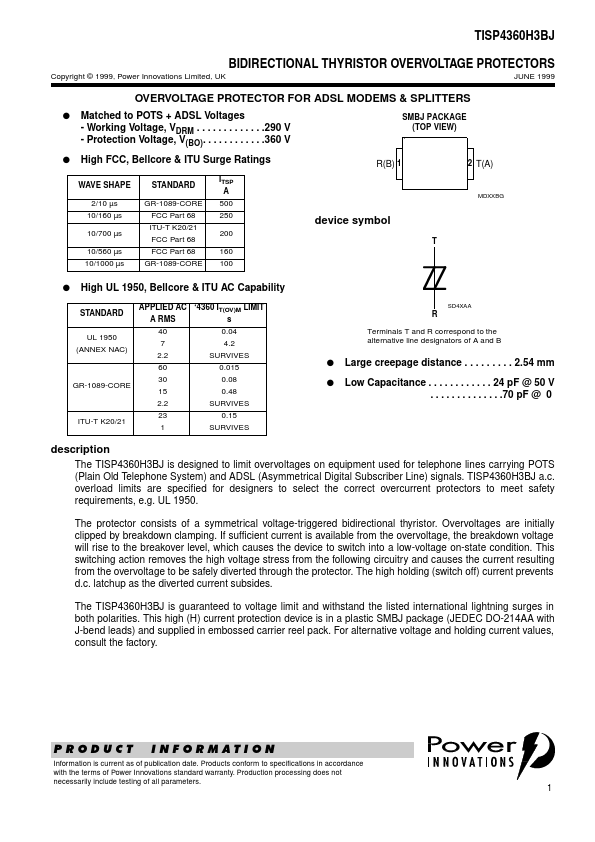
WAVE SHAPE 2/10 µs 10/160 µs 10/700 µs 10/560 µs 10/1000 µs STANDARD GR-1089-CORE FCC Part 68 ITU-T K20/21 FCC Part 68 FCC Part 68 GR-1089-CORE ITSP A 500 250 200
SMBJ PACKAGE (TOP VIEW) q
R(B) 1
2 T(A)
MDXXBG device symbol
160 100 q
High UL 1950, Bellcore & ITU AC Capability
STANDARD UL 1950 (ANNEX NAC) APPLIED AC ‘4360 IT(OV)M LIMIT A RMS s 40 7 2.2 60 GR-1089-CORE 30 15 2.2 ITU-T K20/21 23 1 0.04 4.2 SURVIVES 0.015 0.08 0.48 SURVIVES 0.15 SURVIVES
SD4XAA
R Terminals T and R correspond to the alternative line designators of A and B q q
Large creepage distance
- . . . . 2.54 mm Low Capacitance
- - . . 24 p F @ 50 V
- - . . . .70 p F @ 0 description
The TISP4360H3BJ is designed to limit overvoltages on equipment used for telephone lines carrying POTS (Plain Old Telephone System) and ADSL (Asymmetrical Digital Subscriber Line) signals. TISP4360H3BJ a.c. overload limits are specified for designers to select the correct overcurrent protectors to meet safety requirements, e.g. UL 1950. The protector consists of a symmetrical voltage-triggered bidirectional thyristor. Overvoltages are initially clipped by breakdown clamping. If sufficient current is available from the overvoltage, the breakdown voltage will rise to the breakover level, which causes the device to switch into a low-voltage on-state condition. This switching action removes the high voltage stress from the following circuitry and causes the current resulting from the overvoltage to be safely diverted through the protector. The high holding (switch off) current prevents d.c. latchup as the diverted current...