• Part: PS3100
  • Description: Fuel Gauge Only Module
  • Manufacturer: Power Smart
  • Size: 404.69 KB
Download PS3100 Datasheet PDF
Power Smart
PS3100
PS3100 is Fuel Gauge Only Module manufactured by Power Smart.
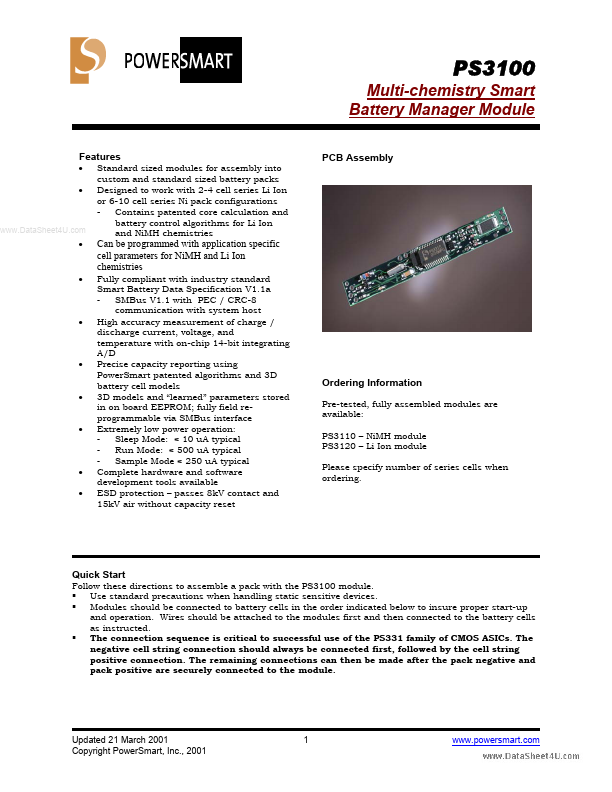
Multi-chemistry Smart Battery Manager Module Features - - Standard sized modules for assembly into custom and standard sized battery packs Designed to work with 2-4 cell series Li Ion or 6-10 cell series Ni pack configurations - Contains patented core calculation and battery control algorithms for Li Ion and Ni MH chemistries PCB Assembly .. - Can be programmed with application specific cell parameters for Ni MH and Li Ion chemistries Fully pliant with industry standard Smart Battery Data Specification V1.1a SMBus V1.1 with PEC / CRC-8 munication with system host High accuracy measurement of charge / discharge current, voltage, and temperature with on-chip 14-bit integrating A/D Precise capacity reporting using Power Smart patented algorithms and 3D battery cell models 3D models and “learned” parameters stored in on board EEPROM; fully field reprogrammable via SMBus interface Extremely low power operation: Sleep Mode: < 10 u A typical Run Mode: < 500 u A typical Sample Mode < 250 u A typical plete hardware and software development tools available ESD protection - passes 8k V contact and 15k V air without capacity reset - - - - - Ordering Information Pre-tested, fully assembled modules are available: PS3110 - Ni MH module PS3120 - Li Ion module Please specify number of series cells when ordering. - - Quick Start Follow these directions to assemble a pack with the PS3100 module. Use standard precautions when handling static sensitive devices. Modules should be connected to battery cells in the order indicated below to insure proper start-up and operation. Wires should be attached to the modules first and then connected to the battery cells as instructed. The connection sequence is critical to successful use of the PS331 family of CMOS ASICs. The negative cell string connection should always be connected first, followed by the cell string positive connection. The remaining connections can then be made after the pack negative and pack...