QT60325B
QT60325B is QMatrix KEYPANEL SENSOR ICS manufactured by QUANTUM.
- Part of the QT60645B comparator family.
- Part of the QT60645B comparator family.
..
32, 48, 64 KEY QMatrix™ KEYPANEL SENSOR ICS
LED DRDY X7 CZ1 CSR AIN MS Vdd Vss YG SS
QT60325B, QT60485B, QT60645B
Advanced second generation QMatrix controllers Up to 32, 48 or 64 touch keys through any dielectric Panel thicknesses to 5 cm or more 100% autocal for life
- no adjustments required Keys individually adjustable for sensitivity, response time, and many other critical parameters Mix and match key sizes & shapes in one panel Passive matrix
- no ponents at the keys Moisture suppression capable AKS™
- Adjacent Key Suppression feature Synchronous noise suppression Sleep mode with wake pin SPI Slave or Master/Slave interface to a host controller Low overhead munications protocol 44-pin TQFP package
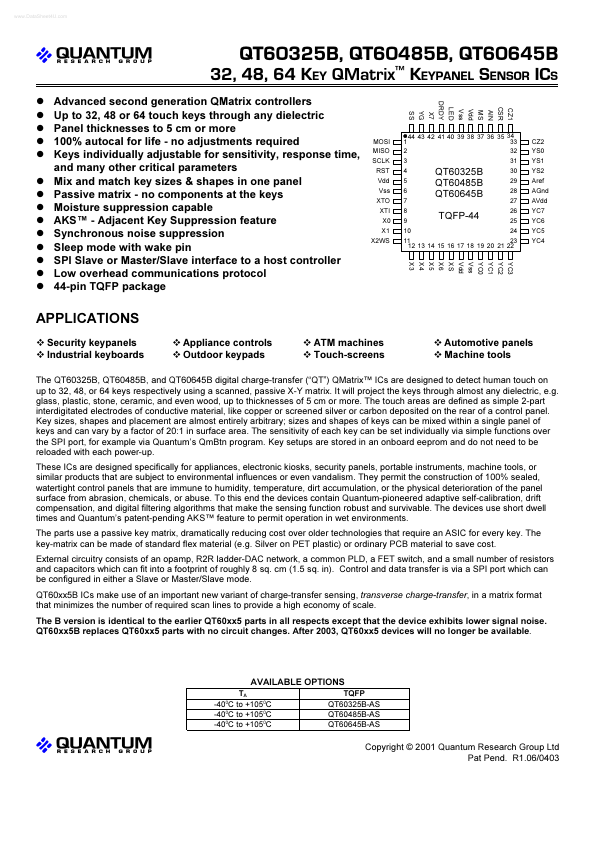
MOSI MISO SCLK RST Vdd Vss XTO XTI X0 X1 X2WS
1 2 3 4 5 6 7
44 43 42 41 40 39 38 37 36 35 34 33 32
CZ2 YS0 YS1 YS2 Aref AGnd AVdd YC7 YC6 YC5 YC4
QT60325B QT60485B QT60645B TQFP-44
31 30 29 28 27 26 25 24
8 9 10
11 23 12 13 14 15 16 17 18 19 20 21 22 XS X6 X5 X4 X3 Vdd YC1 YC0 Vss YC3 YC2
APPLICATIONS
Security keypanels Industrial keyboards Appliance controls Outdoor keypads ATM machines Touch-screens Automotive panels Machine tools
The QT60325B, QT60485B, and QT60645B digital charge-transfer (“QT”) QMatrix™ ICs are designed to detect human touch on up to 32, 48, or 64 keys respectively using a scanned, passive X-Y matrix. It will project the keys through almost any dielectric, e.g. glass, plastic, stone, ceramic, and even wood, up to thicknesses of 5 cm or more. The touch areas are defined as simple 2-part interdigitated electrodes of conductive material, like copper or screened silver or carbon deposited on the rear of a control panel. Key sizes, shapes and placement are almost entirely arbitrary; sizes and shapes of keys can be mixed within a single panel of keys and can vary by a factor of 20:1 in surface area. The sensitivity of each key can be set individually via simple functions over the SPI port, for example via...