RFFC5071
RFFC5071 is WIDEBAND SYNTHESIZER/VCO manufactured by RF Micro Devices.
Features
- 85MHz to 4200MHz LO Frequency Range
- Fractional-N Synthesizer with Very Low Spurious Levels
- Typical Step Size 1.5Hz
- Fully Integrated Low Phase Noise
VCO and LO Buffers
- Integrated Phase Noise
- 0.18° rms at 1GHz
- 0.50° rms at 3GHz
- High Linearity RF Mixer(s)
- 30MHz to 6000MHz Mixer
Frequency Range
- Input IP3 +23d Bm
- Mixer Bias Adjustable for Low
Power Operation
- Full Duplex Mode (RFFC5071)
- 2.7V to 3.3V Power Supply
- Low Current Consumption
- 3- or 4-Wire Serial Interface
Applications
- Wideband Radios
- Distributed Antenna Systems
- Diversity Receivers
- Software Defined Radios
- Frequency Band Shifters
- Point-to-Point Radios
- Wi Max/LTE Infrastructure
- Satellite munications
- Wideband Jammers
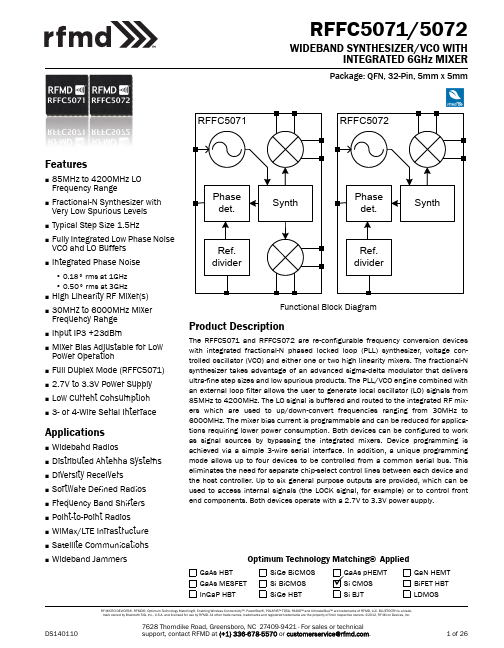
Phase det.
Synth
Ref. divider
Phase det.
Synth
Ref. divider
Functional Block Diagram
Product Description
The RFFC5071 and RFFC5072 are re-configurable frequency conversion devices with integrated fractional-N phased locked loop (PLL) synthesizer, voltage controlled oscillator (VCO) and either one or two high linearity mixers. The fractional-N synthesizer takes advantage of an advanced sigma-delta modulator that delivers ultra-fine step sizes and low spurious products. The PLL/VCO engine bined with an external loop filter allows the user to generate local oscillator (LO) signals from 85MHz to 4200MHz. The LO signal is buffered and routed to the integrated RF mixers which are used to up/down-convert frequencies ranging from 30MHz to 6000MHz. The mixer bias current is programmable and can be reduced for applications requiring lower power consumption. Both devices can be configured to work as signal sources by bypassing the integrated mixers. Device programming is achieved via a simple 3-wire serial interface. In addition, a unique programming mode allows up to four devices to be controlled from a mon serial bus. This eliminates the need for separate chip-select control lines between each device and the host controller. Up to six general purpose...