Datasheet4U Logo Datasheet4U.com

BD733L2EFJ-CE2 - Ultra Low Quiescent Current LDO Regulator

General Description

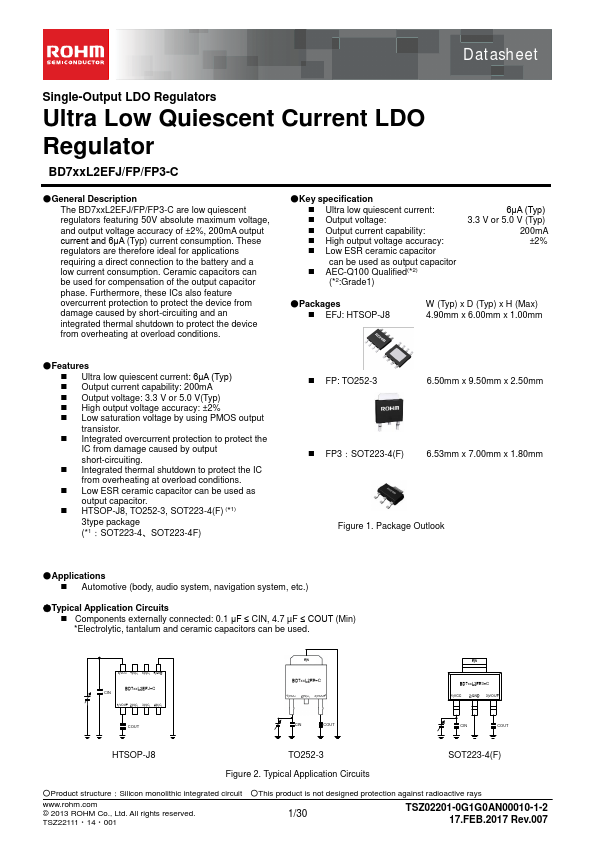
The BD7xxL2EFJ/FP/FP3-C are low quiescent regulators featuring 50V absolute maximum voltage, and output voltage accuracy of ±2%, 200mA output current and 6μA (Typ) current consumption.

Key Features

  • >.
  • Ultra low quiescent current: 6μA (Typ).
  • Output current capability: 200mA.
  • Output voltage: 3.3 V or 5.0 V(Typ).
  • High output voltage accuracy: ±2%.
  • Low saturation voltage by using PMOS output transistor.
  • Integrated overcurrent protection to protect the IC from damage caused by output short-circuiting.
  • Integrated thermal shutdown to protect the IC from overheating at overload conditions.
  • Low ESR ceramic capacitor can be used as output capacitor.
  • HTSOP-.

📥 Download Datasheet

Datasheet Details

Part number BD733L2EFJ-CE2
Manufacturer ROHM
File Size 2.27 MB
Description Ultra Low Quiescent Current LDO Regulator
Datasheet download datasheet BD733L2EFJ-CE2 Datasheet

Full PDF Text Transcription for BD733L2EFJ-CE2 (Reference)

Note: Below is a high-fidelity text extraction (approx. 800 characters) for BD733L2EFJ-CE2. For precise diagrams, and layout, please refer to the original PDF.

Datasheet Single-Output LDO Regulators Ultra Low Quiescent Current LDO Regulator BD7xxL2EFJ/FP/FP3-C ●General Description The BD7xxL2EFJ/FP/FP3-C are low quiescent regula...

View more extracted text
●General Description The BD7xxL2EFJ/FP/FP3-C are low quiescent regulators featuring 50V absolute maximum voltage, and output voltage accuracy of ±2%, 200mA output current and 6μA (Typ) current consumption. These regulators are therefore ideal for applications requiring a direct connection to the battery and a low current consumption. Ceramic capacitors can be used for compensation of the output capacitor phase. Furthermore, these ICs also feature overcurrent protection to protect the device from damage caused by short-circuiting and an integrated thermal shutdown to protect the device from overheating at overload conditio