Datasheet4U Logo Datasheet4U.com

8T74S208C-01 - LVDS Clock Divider and Fanout Buffer

Datasheet Summary

Description

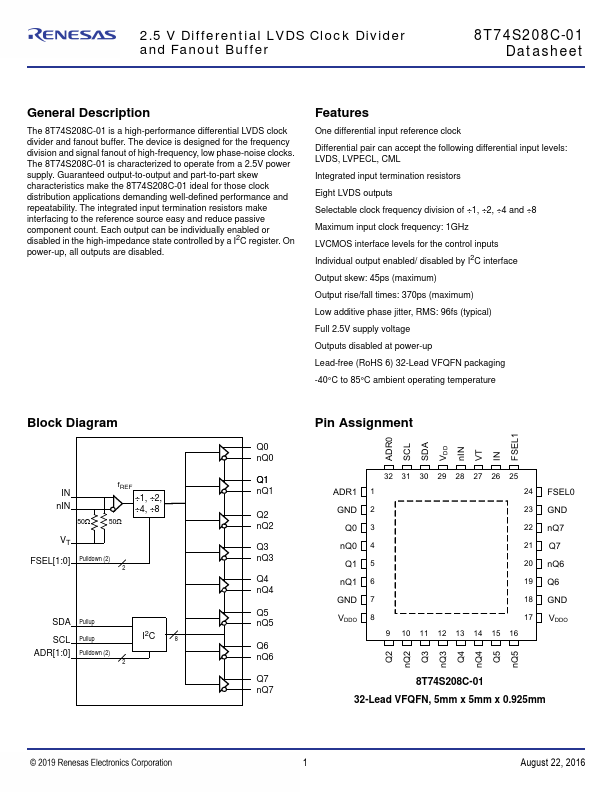
The 8T74S208C-01 is a high-performance differential LVDS clock divider and fanout buffer.

The device is designed for the frequency division and signal fanout of high-frequency, low phase-noise clocks.

The 8T74S208C-01 is characterized to operate from a 2.5V power supply.

Features

  • One differential input reference clock Differential pair can accept the following differential input levels: LVDS, LVPECL, CML Integrated input termination resistors Eight LVDS outputs Selectable clock frequency division of ÷1, ÷2, ÷4 and ÷8 Maximum input clock frequency: 1GHz LVCMOS interface levels for the control inputs Individual output enabled/ disabled by I2C interface Output skew: 45ps (maximum) Output rise/fall times: 370ps (maximum) Low additive phase jitter, RMS: 96fs (typical) Full 2.

📥 Download Datasheet

Datasheet preview – 8T74S208C-01

Datasheet Details

Part number 8T74S208C-01
Manufacturer Renesas
File Size 634.20 KB
Description LVDS Clock Divider and Fanout Buffer
Datasheet download datasheet 8T74S208C-01 Datasheet
Additional preview pages of the 8T74S208C-01 datasheet.
Other Datasheets by Renesas

Full PDF Text Transcription

Click to expand full text
2.5 V Differential LVDS Clock Divider and Fanout Buffer 8T74S208C-01 Datasheet General Description The 8T74S208C-01 is a high-performance differential LVDS clock divider and fanout buffer. The device is designed for the frequency division and signal fanout of high-frequency, low phase-noise clocks. The 8T74S208C-01 is characterized to operate from a 2.5V power supply. Guaranteed output-to-output and part-to-part skew characteristics make the 8T74S208C-01 ideal for those clock distribution applications demanding well-defined performance and repeatability. The integrated input termination resistors make interfacing to the reference source easy and reduce passive component count. Each output can be individually enabled or disabled in the high-impedance state controlled by a I2C register.
Published: |