Datasheet4U Logo Datasheet4U.com

RT6551B - Complete DDR Memory Power Supply Controller

This page provides the datasheet information for the RT6551B, a member of the RT6551A Complete DDR Memory Power Supply Controller family.

Description

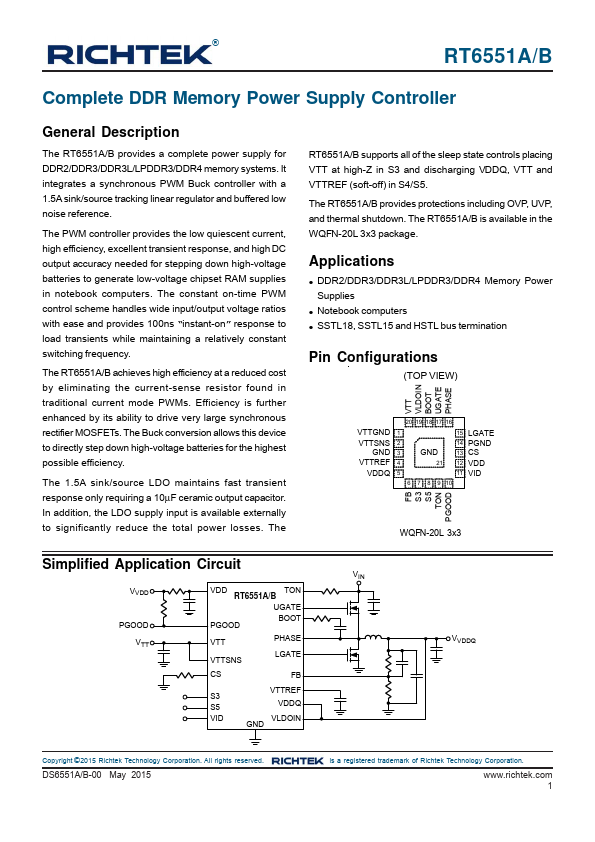
The RT6551A/B provides a complete power supply for DDR2/DDR3/DDR3L/LPDDR3/DDR4 memory systems.

It integrates a synchronous PWM Buck controller with a 1.5A sink/source tracking linear regulator and buffered low noise reference.

Features

  • PWM Controller  Adjustable Current Limit with Low-Side RDS(ON) Sensing  Low Quiescent Supply Current  Quick Load-Step Response within 100ns  1% VVDDQ Accuracy Over Line and Load  Adjustable 0.675V to 3.3V Output Range for 1.8V (DDR2), 1.5V (DDR3), 1.35V (DDR3L), 1.2V (LPDDR3) and 1.2V (DDR4)  4.5V to 26V Battery Input Range  Resistor Adjustable Frequency  Over-/Under-Voltage Protection  Internal Voltage Ramp Soft-Start  Drives Large Synchronous Rectifier MOSFETs  Power Good Indi.

📥 Download Datasheet

Datasheet preview – RT6551B

Datasheet Details

Part number RT6551B
Manufacturer Richtek
File Size 284.16 KB
Description Complete DDR Memory Power Supply Controller
Datasheet download datasheet RT6551B Datasheet
Additional preview pages of the RT6551B datasheet.
Other Datasheets by Richtek

Full PDF Text Transcription

Click to expand full text
® RT6551A/B Complete DDR Memory Power Supply Controller General Description The RT6551A/B provides a complete power supply for DDR2/DDR3/DDR3L/LPDDR3/DDR4 memory systems. It integrates a synchronous PWM Buck controller with a 1.5A sink/source tracking linear regulator and buffered low noise reference. The PWM controller provides the low quiescent current, high efficiency, excellent transient response, and high DC output accuracy needed for stepping down high-voltage batteries to generate low-voltage chipset RAM supplies in notebook computers. The constant on-time PWM control scheme handles wide input/output voltage ratios with ease and provides 100ns “instant-on” response to load transients while maintaining a relatively constant switching frequency.
Published: |