Datasheet4U Logo Datasheet4U.com

RTQ2106-QA - Synchronous Step-Down Converter

General Description

The RTQ2106 is a 3A, high-efficiency, current mode synchronous step-down converter which is optimized for automotive applications.

The device operates with input voltages from 3V to 36V and is protected from load dump transients up to 42V, eases input surge protection design.

Key Features

  • AEC-Q100 Grade 1 Qualified.
  • Wide Input Voltage Range  4V to 36V  3V to 36V (Soft-start is finished).
  • Wide Output Voltage Range : 0.8V to VIN.
  • Maximum Output Current : 3A.
  • Peak Current Mode Control.
  • Integrated 90mΩ Switch and 90mΩ Synchronous Rectifier.
  • Low Quiescent Current : 40μA.
  • Fast 60ns Minimum Switch On-Time.
  • Ultra-Short 65ns Minimum Switch Off-Time.
  • Synchronizable Switching : 300kHz to 2.2MHz.
  • Selectable PSM/FPWM at Light Load.

📥 Download Datasheet

Datasheet Details

Part number RTQ2106-QA
Manufacturer Richtek
File Size 532.43 KB
Description Synchronous Step-Down Converter
Datasheet download datasheet RTQ2106-QA Datasheet

Full PDF Text Transcription for RTQ2106-QA (Reference)

Note: Below is a high-fidelity text extraction (approx. 800 characters) for RTQ2106-QA. For precise diagrams, and layout, please refer to the original PDF.

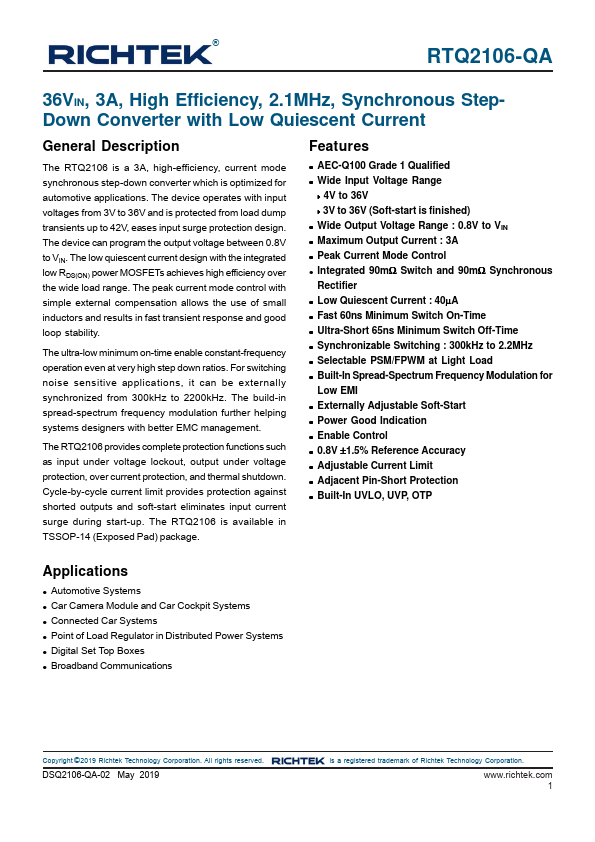
® RTQ2106-QA 36VIN, 3A, High Efficiency, 2.1MHz, Synchronous StepDown Converter with Low Quiescent Current General Description The RTQ2106 is a 3A, high-efficiency, curre...

View more extracted text
urrent General Description The RTQ2106 is a 3A, high-efficiency, current mode synchronous step-down converter which is optimized for automotive applications. The device operates with input voltages from 3V to 36V and is protected from load dump transients up to 42V, eases input surge protection design. The device can program the output voltage between 0.8V to VIN. The low quiescent current design with the integrated low RDS(ON) power MOSFETs achieves high efficiency over the wide load range. The peak current mode control with simple external compensation allows the use of small inductors and results in fast transient respo