Datasheet4U Logo Datasheet4U.com

BU8710AKS - 4-channel ADPCM transcoder for digital cordless telephone base stations

Description

101 Communication ICs BU8710AKS 102 Communication ICs BU8710AKS FElectrical characteristics DC characteristics (unless otherwise noted, Ta = 25_C, VDD = 5.0V) 103 Communication ICs AC characteristics (unless otherwise noted, Ta = 25_C, VDD = 5.0V) BU8710AKS 104 Communication ICs FInput

Features

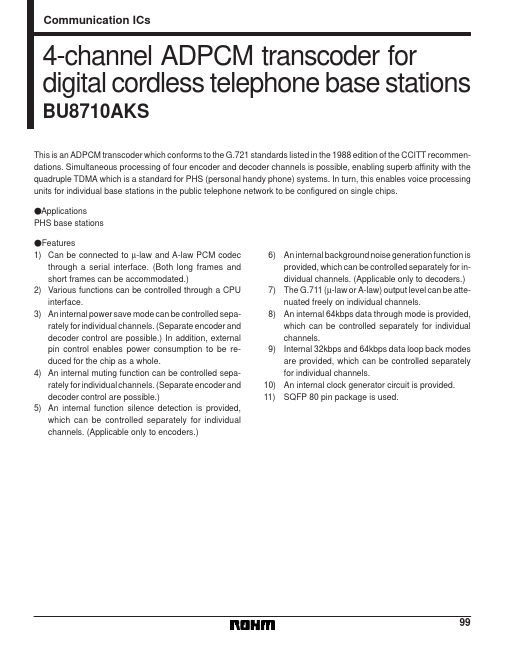
  • 1) Can be connected to µ-law and A-law PCM codec through a serial interface. (Both long frames and short frames can be accommodated. ) 2) Various functions can be controlled through a CPU interface. 3) An internal power save mode can be controlled separately for individual channels. (Separate encoder and decoder control are possible. ) In addition, external pin control enables power consumption to be reduced for the chip as a whole. 4) An internal muting function can be controlled separately for i.

📥 Download Datasheet

Datasheet preview – BU8710AKS

Datasheet Details

Part number BU8710AKS
Manufacturer ROHM
File Size 601.42 KB
Description 4-channel ADPCM transcoder for digital cordless telephone base stations
Datasheet download datasheet BU8710AKS Datasheet
Additional preview pages of the BU8710AKS datasheet.
Other Datasheets by Rohm

Full PDF Text Transcription

Click to expand full text
Communication ICs 4-channel ADPCM transcoder for digital cordless telephone base stations BU8710AKS This is an ADPCM transcoder which conforms to the G.721 standards listed in the 1988 edition of the CCITT recommendations. Simultaneous processing of four encoder and decoder channels is possible, enabling superb affinity with the quadruple TDMA which is a standard for PHS (personal handy phone) systems. In turn, this enables voice processing units for individual base stations in the public telephone network to be configured on single chips. FApplications PHS base stations FFeatures 1) Can be connected to µ-law and A-law PCM codec through a serial interface. (Both long frames and short frames can be accommodated.) 2) Various functions can be controlled through a CPU interface.
Published: |