Datasheet4U Logo Datasheet4U.com

ST232B - 5V Powered Multi-channel RS-232 Drivers/Receivers

Download the ST232B datasheet PDF. This datasheet also covers the ST232C variant, as both devices belong to the same 5v powered multi-channel rs-232 drivers/receivers family and are provided as variant models within a single manufacturer datasheet.

General Description

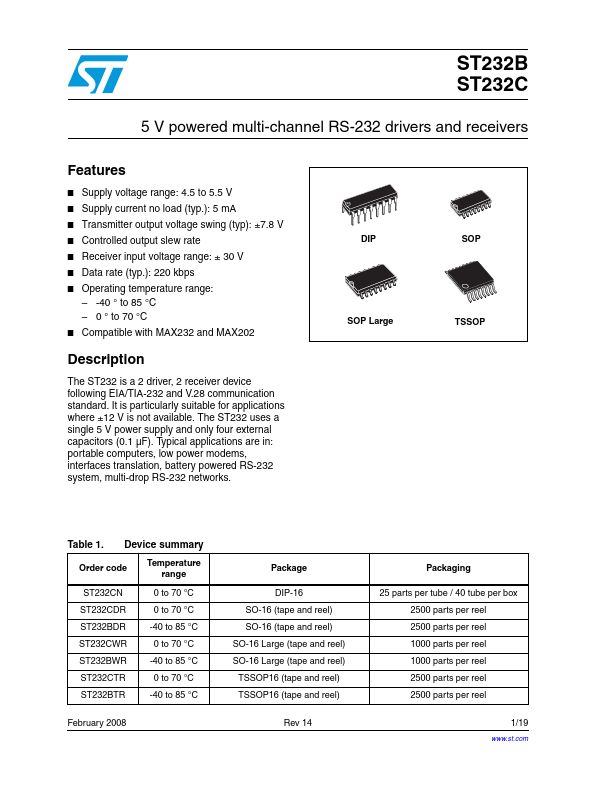
The ST232 is a 2 driver, 2 receiver device following EIA/TIA-232 and V.28 communication standard.

It is particularly suitable for applications where ±12 V is not available.

The ST232 uses a single 5 V power supply and only four external capacitors (0.1 µF).

Key Features

  • Supply voltage range: 4.5 to 5.5 V.
  • Supply current no load (typ. ): 5 mA.
  • Transmitter output voltage swing (typ): ±7.8 V.
  • Controlled output slew rate.
  • Receiver input voltage range: ± 30 V.
  • Data rate (typ. ): 220 kbps.
  • Operating temperature range:.
  • -40 ° to 85 °C.
  • 0 ° to 70 °C.
  • Compatible with MAX232 and MAX202.

📥 Download Datasheet

Note: The manufacturer provides a single datasheet file (ST232C_STMicroelectronics.pdf) that lists specifications for multiple related part numbers.

Full PDF Text Transcription (Reference)

The following content is an automatically extracted verbatim text from the original manufacturer datasheet and is provided for reference purposes only.

View original datasheet text
ST232B ST232C 5 V powered multi-channel RS-232 drivers and receivers Features ■ Supply voltage range: 4.5 to 5.5 V ■ Supply current no load (typ.): 5 mA ■ Transmitter output voltage swing (typ): ±7.8 V ■ Controlled output slew rate ■ Receiver input voltage range: ± 30 V ■ Data rate (typ.): 220 kbps ■ Operating temperature range: – -40 ° to 85 °C – 0 ° to 70 °C ■ Compatible with MAX232 and MAX202 Description The ST232 is a 2 driver, 2 receiver device following EIA/TIA-232 and V.28 communication standard. It is particularly suitable for applications where ±12 V is not available. The ST232 uses a single 5 V power supply and only four external capacitors (0.1 µF).