STMPS2262
STMPS2262 is Enhanced dual-channel power switche manufactured by STMicroelectronics.
- Part of the STMPS2242 comparator family.
- Part of the STMPS2242 comparator family.
STMPS2242, STMPS2252 STMPS2262, STMPS2272
Enhanced dual-channel power switches
Features
- 100 mΩ high-side MOSFET switch
- 500 m A/1000 m A continuous current per channel
- Thermal protection
- Independent short-circuit protection with overcurrent logic output
- Operating range from 2.7 V to 5.5 V
- CMOS and TTL patible inputs
- 2.5 ms typical rise time
- Undervoltage lockout
- 13 µA maximum standby supply current
- Ambient temperature range: -40 °C to 85 °C
- 8 k V ESD protection
- Reverse current protection
- Fault blanking
Description
The STMPS2242/2252/2262/2272 power distribution switches are intended for applications where heavy capacitive loads and short-circuits are likely to be encountered. These devices incorporate 100 mΩ MOSFET high-side power switches for power distribution systems that require multiple power switches in a single package.
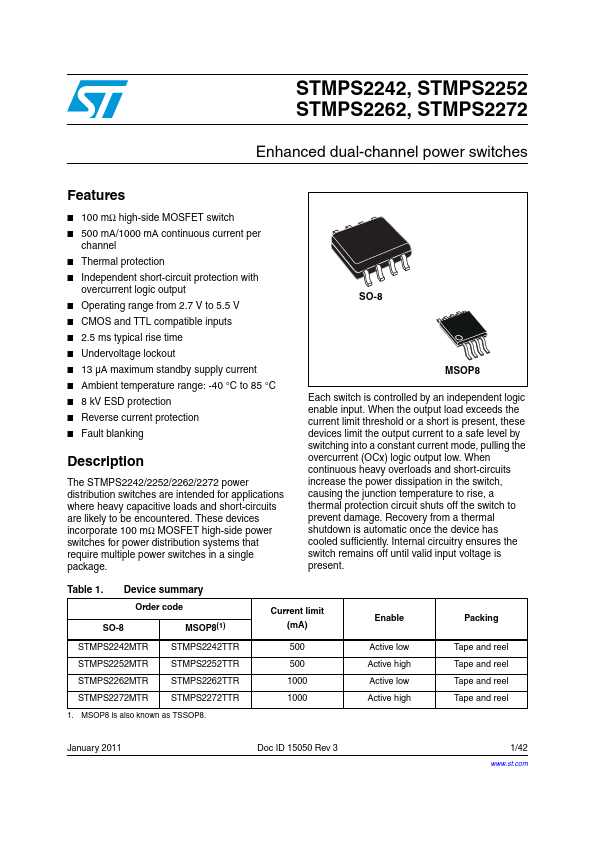
SO-8
MSOP8
Each switch is controlled by an independent logic enable input. When the output load exceeds the current limit threshold or a short is present, these devices limit the output current to a safe level by switching into a constant current mode, pulling the overcurrent (OCx) logic output low. When continuous heavy overloads and short-circuits increase the power dissipation in the switch, causing the junction temperature to rise, a thermal protection circuit shuts off the switch to prevent damage. Recovery from a thermal shutdown is automatic once the device has cooled sufficiently. Internal circuitry ensures the switch remains off until valid input voltage is present.
Table 1. Device summary
Order code
SO-8
MSOP8(1)
STMPS2242MTR STMPS2242TTR
STMPS2252MTR STMPS2262MTR STMPS2272MTR
STMPS2252TTR STMPS2262TTR STMPS2272TTR
1. MSOP8 is also known as TSSOP8.
Current limit (m...