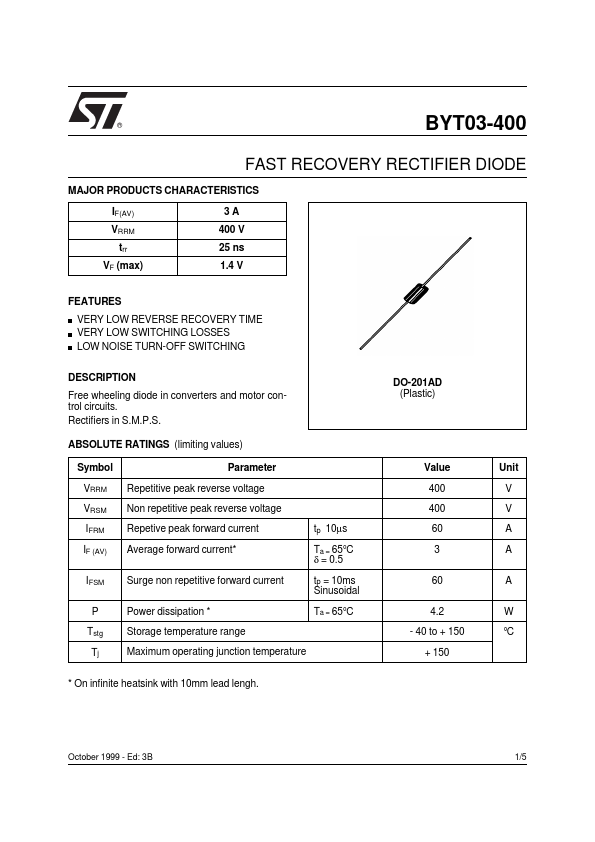
BYT03-400
BYT03-400 is FAST RECOVERY RECTIFIER DIODE manufactured by STMicroelectronics.
EATURES VERY LOW REVERSE RECOVERY TIME VERY LOW SWITCHING LOSSES LOW NOISE TURN-OFF SWITCHING DESCRIPTION Free wheeling diode in converters and motor control circuits. Rectifiers in S.M.P.S. ABSOLUTE RATINGS (limiting values) Symbol VRRM VRSM IFRM IF (AV) IFSM P Tstg Tj Parameter Repetitive peak reverse voltage Non repetitive peak reverse voltage Repetive peak forward current Average forward current- Surge non repetitive forward current Power dissipation
- Storage temperature range Maximum operating junction temperature tp 10µs Ta = 65°C δ = 0.5 tp = 10ms Sinusoidal Ta = 65°C Value 400 400 60 3 60 4.2
- 40 to + 150 + 150 Unit V V A A A W °C
DO-201AD (Plastic)
- On infinite heatsink with 10mm lead lengh.
October 1999
- Ed: 3B
1/5
THERMAL RESISTANCES Symbol Rth (j
- a) Junction-ambient- Parameter Value 20 Unit °C/W
- On infinite heatsink with 10mm lead lengh.
STATIC ELECTRICAL CHARACTERISTICS Synbol IR Tj = 25C Tj = 100C VF Tj = 25C Tj = 100C IF = 3A Test Conditions VR = VRRM Min. Typ. Max. 20 0.5 1.5 1.4 Unit µA m A V
RECOVERY CHARACTERISTICS Symbol trr Tj = 25C Test Conditions IF = 1A IF = 0.5A di F/dt =
- 15A/µs VR = 30V IR = 1 A Irr = 0.25A Min. Typ. Max. 55 25 Unit ns
TURN-OFF SWITCHING CHARACTERISTICS
- Without series inductance Symbol t IRM IRM di F/dt =
- 50A/µs di F/dt = -50A/µs Test Conditions VCC = 200 V Lp ≤ 0.05µH IF = 3A Tj = 100°C Min. Typ. 35 1.5 Max. 50 2 Unit ns A
To evaluate the conduction losse use the following equations : P = 1.1 x IF(AV) + 0.050 IF2(RMS) VF = 1.1 + 0.050 IF
2/5
Fig. 1: Maximum average power dissipation versus average forward current. Fig. 2: Average forward current versus ambient temperature.
Fig.3 : Thermal resistance versus lead length.
Fig. 5: Peak forward current versus peak forward voltage drop (maximum values).
Fig. 4: Transient thermal impedance junction ambient for mounting n° 2 versus pulse duration (L = 10 mm).
3/5
Fig. 7: Recovery time versus d IF/dt. Fig. 8: Peak forward...