TSV6390A
TSV6390A is Micropower / wide bandwidth CMOS op-amps manufactured by STMicroelectronics.
Features
Low offset voltage: 500 µV max (A version) Low power consumption: 60 µA typ at 5 V Low supply voltage: 1.5 V
- 5.5 V Gain bandwidth product: 2.4 MHz typical Stable in gain configuration (-3 or 4) Low power shutdown mode: 5 n A typical High output current: 63 m A at VCC = 5 V Low input bias current: 1 p A typical Rail-to-rail input and output Extended temperature range: -40 °C to 125 °C 4 k V human body model
Applications
Battery-powered applications Portable devices
Signal conditioning Active filtering Medical instrumentation
Description
The TSV6390, TSV6391, and their "A" versions are single operational amplifiers (op amps) offering low voltage, low power operation, and rail-to-rail input and output.
With a very low input bias current and low offset voltage (500 µV maximum for the A version), the TSV6390 and TSV6391 are ideal for applications requiring precision. The devices can operate at power supplies ranging from 1.5 to 5.5 V, and are therefore ideal for battery-powered devices, extending battery life.
When used with a gain (above -3 or 4), these products feature an excellent speed/power consumption ratio, offering a 2.4 MHz gain bandwidth product while consuming only 60 µA at a 5 V supply voltage.
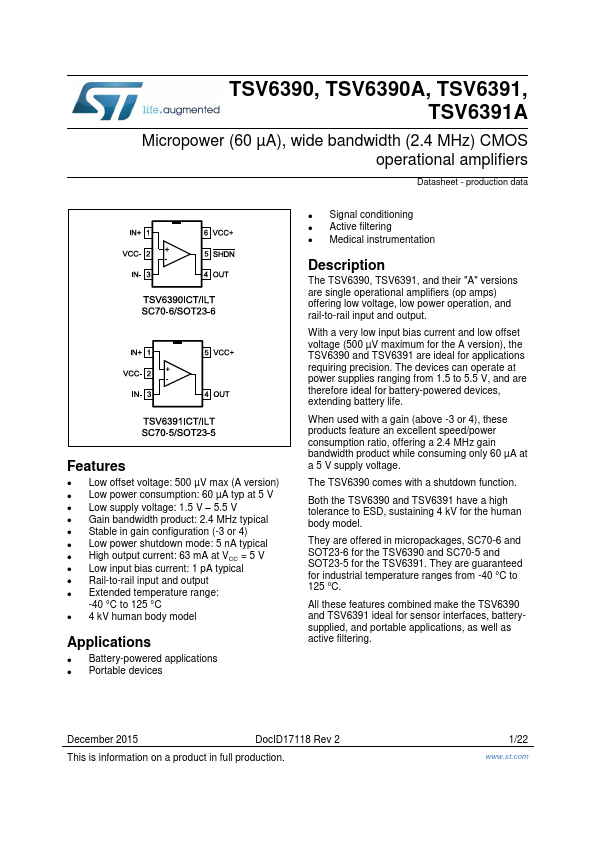
The TSV6390 es with a shutdown function.
Both the TSV6390 and TSV6391 have a high tolerance to ESD, sustaining 4 k V for the human body model.
They are offered in micropackages, SC70-6 and SOT23-6 for the TSV6390 and SC70-5 and SOT23-5 for the TSV6391. They are guaranteed for industrial temperature ranges from -40 °C to 125 °C.
All these features bined make the TSV6390 and TSV6391 ideal for sensor interfaces, batterysupplied, and portable applications, as well as active filtering.
December 2015
Doc ID17118 Rev 2
This is information on a product in full production.
1/22
.st.
Contents
TSV6390, TSV6390A, TSV6391, TSV6391A
Contents
1 Absolute maximum ratings and operating conditions 3 2 Electrical characteristics...