MTC110A
MTC110A is Thyristor/Diode Module manufactured by Santry.
- Part of the MTC90A comparator family.
- Part of the MTC90A comparator family.
Thyristor/Thyristor Module Thyristor/Diode Module
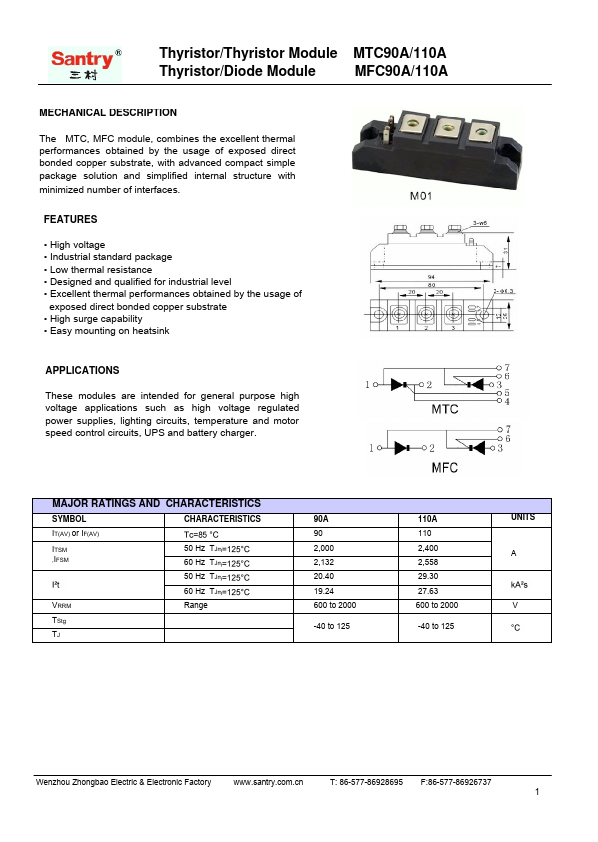
MECHANICAL DESCRIPTION The MTC, MFC module, bines the excellent thermal performances obtained by the usage of exposed direct bonded copper substrate, with advanced pact simple package solution and simplified internal structure with minimized number of interfaces. Features
- High voltage
- Industrial standard package
- Low thermal resistance
- Designed and qualified for industrial level
- Excellent thermal performances obtained by the usage of exposed direct bonded copper substrate
- High surge capability
- Easy mounting on heatsink
MTC90A/110A MFC90A/110A
APPLICATIONS These modules are intended for general purpose high voltage applications such as high voltage regulated power supplies, lighting circuits, temperature and motor speed control circuits, UPS and battery charger.
MAJOR RATINGS AND CHARACTERISTICS
SYMBOL IT(AV) or IF(AV) ITSM ,IFSM 50 Hz TJm 60 Hz TJm 50 Hz TJm 60 Hz TJm VRRM TStg TJ Range CHARACTERISTICS 90A 90 2,000 2,132 20.40 19.24 600 to 2000 -40 to 125 110A 110 2,400 2,558 29.30 27.63 600 to 2000 -40 to 125 V A UNITS
Wenzhou Zhongbao Electric & Electronic Factory
.santry..cn
T: 86-577-86928695
F:86-577-86926737
Thyristor/Thyristor Module Thyristor/Diode Module
ON-STATE CONDUCTION
PARAMETER Maximum average on-state current (thyristors) Maximum average forward current (diodes) Maximum peak, one-cycle non-repetitive on-state or forward current SYMBOL TEST CONDITIONS IT(AV) IF(AV) ITSM or IFSM
MTC90A/110A MFC90A/110A
90A 90
110A UNITS 110 2,400 2,558 29.30 27.63 V mΩ V A
180?conduction, half sine wave, T C t = 10 ms t = 8.3 ms t = 10 ms t = 8.3 ms 80 % VRRM
Sinusoidal half wave, 2,000 initial TJ = TJ reapplied 2,132 maximum 20.40 Initial TJ = TJ No voltage reapplied maximum 19.24 TJ = TJ maximum TJ = TJ maximum 1.26 1.30
Maximum value or threshold voltage Maximum value of on-state slope resistance Maximum peak on-state or forward voltage
VT(TO) rt VTM VFM ITM = π x IT(AV)...