SC2982
SC2982 is 50mA Ultra Low Dropout/ Low Noise Micropower Linear Regulator manufactured by SEMTECH.
POWER MANAGEMENT Description
The SC2982 is a 50m A ultra low dropout linear regulator with a built in CMOS/TTL logic level enable switch. It is designed specifically for battery powered applications where low quiescent current and low dropout are critical for battery longevity.
50m A Ultra Low Dropout, Low Noise Micropower Linear Regulator
PRELIMINARY Features
Ultra low dropout voltage
- 100m V @ 50m A Guaranteed 50m A output current Low ground pin current at all loads <1µA quiescent current in shutdown Wide input supply voltage range 2.5V to 16V Wide output voltage range Excellent line regulation Industrial temperature range Surface mount packaging (5 pin SOT-23)
SC2982 u u u u u u The SC2982 uses a Semtech proprietary internal PNP device for the pass element, providing a low dropout u voltage of 100m V at a load of 50m A, while maintaining a u u ground pin current of 600µA.
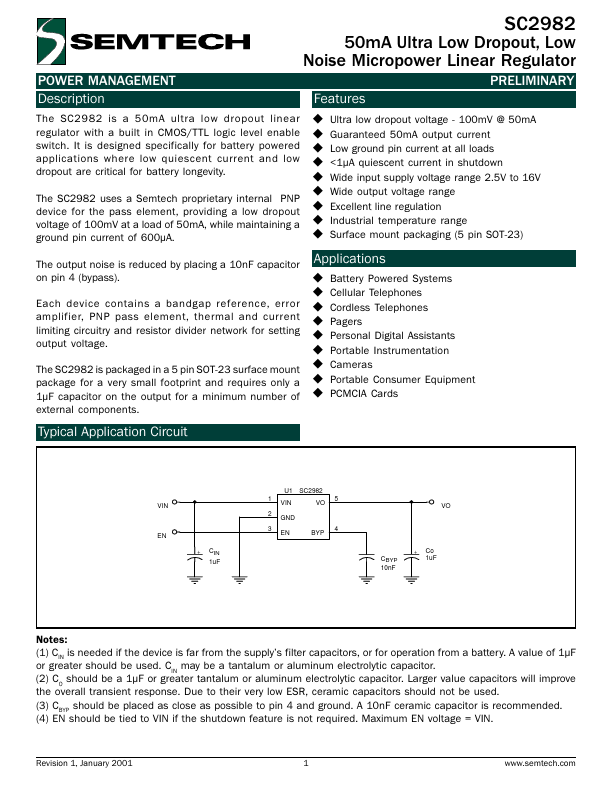
The output noise is reduced by placing a 10n F capacitor on pin 4 (bypass).
Applications
Battery Powered Systems Cellular Telephones Cordless Telephones Pagers Personal Digital Assistants Portable Instrumentation Cameras Portable Consumer Equipment PCMCIA Cards u u Each device contains a bandgap reference, error u amplifier, PNP pass element, thermal and current u limiting circuitry and resistor divider network for setting u output voltage. u The SC2982 is packaged in a 5 pin SOT-23 surface mount u package for a very small footprint and requires only a u 1µF capacitor on the output for a minimum number of u external ponents.
Typical Application Circuit
U1 SC2982 1 VIN 2 3 EN + CIN 1u F VIN GND EN BYP 4 Co 1u F VO 5 VO
+ CBYP 10n F
Notes: (1) CIN is needed if the device is far from the supplys filter capacitors, or for operation from a battery. A value of 1µF or greater should be used. CIN may be a tantalum or aluminum electrolytic capacitor. (2) CO should be a 1µF or greater tantalum or aluminum electrolytic capacitor. Larger value capacitors will improve the overall transient response. Due...