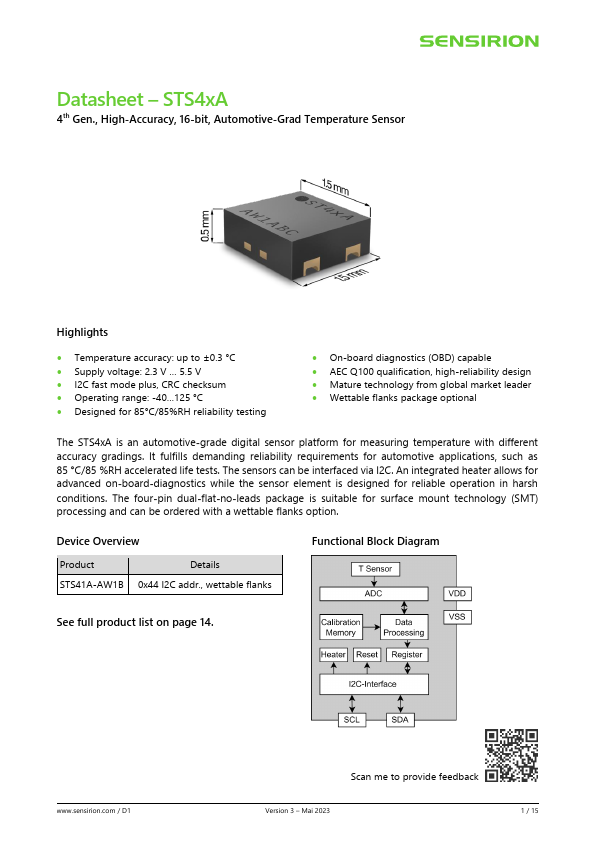
STS41A
STS41A is Automotive-Grad Temperature Sensor manufactured by Sensirion.
- STS4x A
4th Gen., High-Accuracy, 16-bit, Automotive-Grad Temperature Sensor
Highlights
- Temperature accuracy: up to ±0.3 °C
- Supply voltage: 2.3 V … 5.5 V
- I2C fast mode plus, CRC checksum
- Operating range: -40…125 °C
- Designed for 85°C/85%RH reliability testing
- On-board diagnostics (OBD) capable
- AEC Q100 qualification, high-reliability design
- Mature technology from global market leader
- Wettable flanks package optional
The STS4x A is an automotive-grade digital sensor platform for measuring temperature with different accuracy gradings. It fulfills demanding reliability requirements for automotive applications, such as 85 °C/85 %RH accelerated life tests. The sensors can be interfaced via I2C. An integrated heater allows for advanced on-board-diagnostics while the sensor element is designed for reliable operation in harsh conditions. The four-pin dual-flat-no-leads package is suitable for surface mount technology (SMT) processing and can be ordered with a wettable flanks option.
Device Overview
Product
Details
STS41A-AW1B 0x44 I2C addr., wettable flanks
Functional Block Diagram
See full product list on page 14.
.sensirion. / D1
Scan me to provide feedback
Version 3
- Mai 2023
1 / 15
Contents
1 Quick Start Guide................................................................................................................................................................................ 3 2 Sensor Specifications ........................................................................................................................................................................ 4
2.1 Relative Humidity ..................................................................................................................................................................... 4 3 Electrical Specifications ............................................................................................................................................