SFH636
SFH636 is HIGH SPEED OPTOCOUPLER manufactured by Siemens Semiconductor Group.
FEATURES
- High Speed Optocoupler without Base Connection
- Ga Al As Emitter
- Integrated Detector with Photodiode and Transistor
- High Data Transmission Rate: 1 MBit/s
- TTL patible
- Open Collector Output
- CTR at IF=16 m A, VO=0.4 V, VCC=4.5 V, TA=25°C: ≥19%
- Good CTR Linearity Relative to Forward Current
- Field Effect Stable by TRIOS® (TRansparent IOn Shield)
- Low Coupling Capacitance
- d V/dt: typ. 10 k V/µ s
- Isolation Test Voltage: 5300 VACRMS
- VDE 0884 Available with Option 1
- UL Approval, File #E52744 APPLICATIONS
- IGBT Drivers
- Data munications
- Programmable Controllers
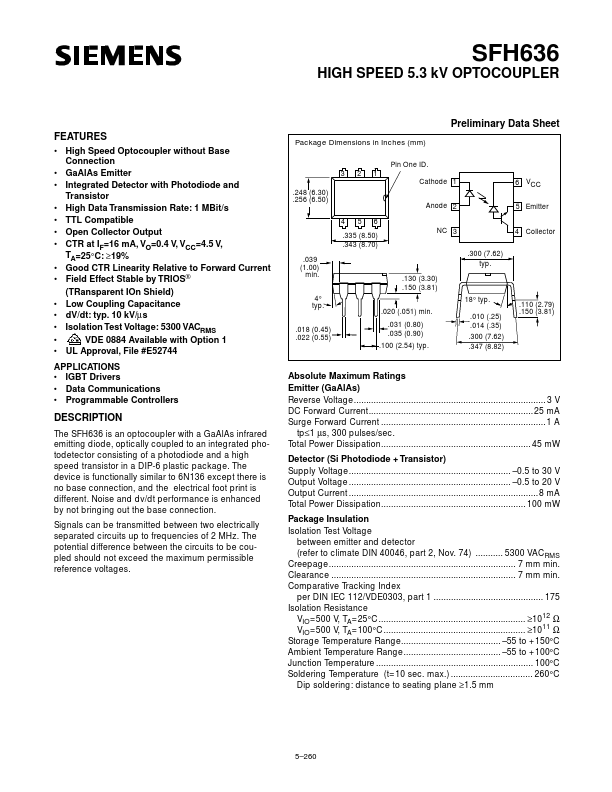
Package Dimensions in Inches (mm)
Pin One ID. 3 .248 (6.30) .256 (6.50) 4 5 6 NC 3 .300 (7.62) typ. .130 (3.30) .150 (3.81) 18° typ. .020 (.051) min. .031 (0.80) .035 (0.90) .100 (2.54) typ. .010 (.25) .014 (.35) .300 (7.62) .347 (8.82) .110 (2.79) .150 (3.81) 4 Collector 2 1 Cathode 1 Anode 2 6 VCC 5 Emitter
.335 (8.50) .343 (8.70) .039 (1.00) min. 4° typ. .018 (0.45) .022 (0.55)
DESCRIPTION
The SFH636 is an optocoupler with a Ga Al As infrared emitting diode, optically coupled to an integrated photodetector consisting of a photodiode and a high speed transistor in a DIP-6 plastic package. The device is functionally similar to 6N136 except there is no base connection, and the electrical foot print is different. Noise and dv/dt performance is enhanced by not bringing out the base connection. Signals can be transmitted between two electrically separated circuits up to frequencies of 2 MHz. The potential difference between the circuits to be coupled should not exceed the maximum permissible reference voltages.
Absolute Maximum Ratings Emitter (Ga Al As) Reverse Voltage 3 V DC Forward Current 25 m A Surge Forward Current 1 A tp≤1 µs, 300 pulses/sec. Total Power Dissipation...