TLE4261-2GL
TLE4261-2GL is 5-V Low-Drop Voltage Regulator manufactured by Siemens Semiconductor Group.
5-V Low-Drop Voltage Regulator
TLE 4261-2
Features
- -
- -
- -
- -
- -
- -
- - High accuracy 5 V ± 2% Very low-drop voltage Very low quiescent current Low starting-current consumption Proof against reverse polarity Input voltage up to 42 V Overvoltage protection up to 65 V (≤ 400 ms) Short-circuit-proof External setting of reset delay Integrated watchdog circuit Wide temperature range Overtemperature protection Suitable for automotive use EMC proofed (100 V/m) Ordering Code Q67000-A9110 Q67000-A9140 Q67006-A9193 Package P-TO220-7-1 P-DSO-20-6 (SMD) P-TO220-7-8 (SMD)
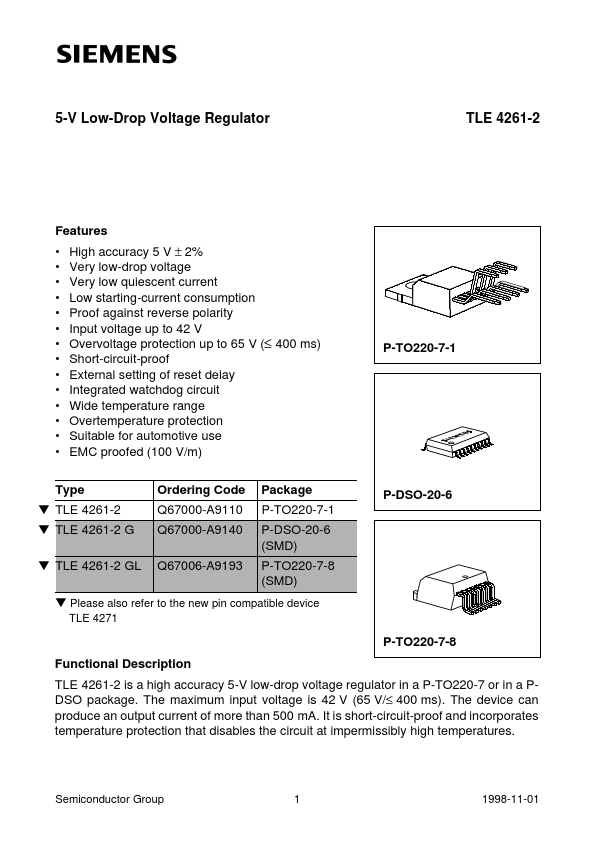
P-TO220-7-1
Type w TLE 4261-2 w TLE 4261-2 G w TLE 4261-2 GL
P-DSO-20-6 w Please also refer to the new pin patible device
TLE 4271
P-TO220-7-8 Functional Description TLE 4261-2 is a high accuracy 5-V low-drop voltage regulator in a P-TO220-7 or in a PDSO package. The maximum input voltage is 42 V (65 V/≤ 400 ms). The device can produce an output current of more than 500 m A. It is short-circuit-proof and incorporates temperature protection that disables the circuit at impermissibly high temperatures.
Semiconductor Group
1998-11-01
TLE 4261-2
Application Description The IC regulates an input voltage VI in the range 6 V < VI < 40 V to VQrated = 5.0 V. A reset signal is generated for an output voltage VO of < 4.75 V. The reset delay can be set with an external capacitor. A connected microprocessor is monitored by the integrated watchdog circuit; if pulses are missing, the reset output is set low. The pulse repetition rate can be set within wide limits with the capacitor for reset delay. If this input is connected to a voltage of > 6 V, the watchdog function is deactivated. The device also Features an inhibit input, which is activated by a voltage of > 6 V and then works on this input through internal hysteresis up to approx. 3 V. A voltage of < 2 V on the inhibit input turns off the regulator, current drain then dropping to max. 50 µA. Design Notes for External ponents The input...