CXP82612
CXP82612 is CMOS 8-bit Single Chip Microcomputer manufactured by Sony Semiconductor Solutions.
Description
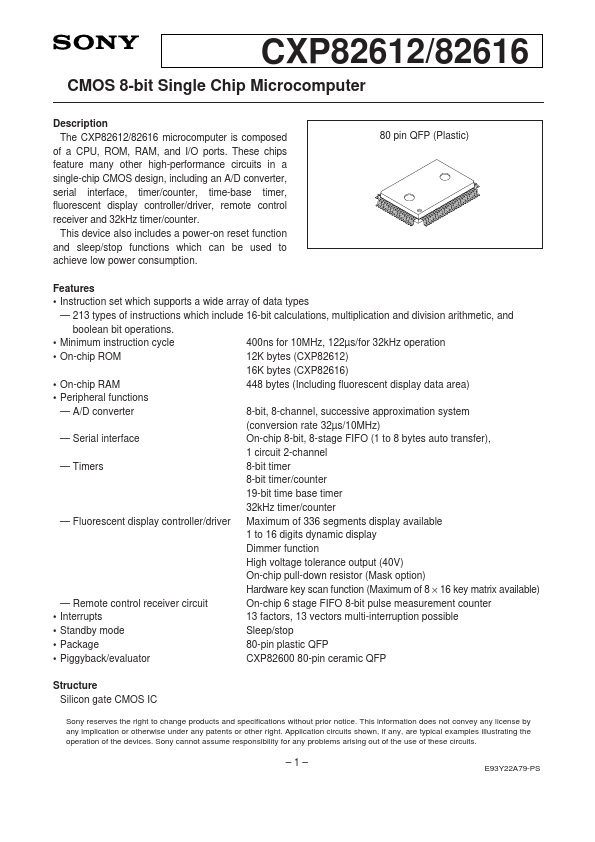
The CXP82612/82616 microputer is posed of a CPU, ROM, RAM, and I/O ports. These chips feature many other high-performance circuits in a single-chip CMOS design, including an A/D converter, serial interface, timer/counter, time-base timer, fluorescent display controller/driver, remote control receiver and 32k Hz timer/counter. This device also includes a power-on reset function and sleep/stop functions which can be used to achieve low power consumption. 80 pin QFP (Plastic)
Features
- Instruction set which supports a wide array of data types
- 213 types of instructions which include 16-bit calculations, multiplication and division arithmetic, and boolean bit operations.
- Minimum instruction cycle 400ns for 10MHz, 122µs/for 32k Hz operation
- On-chip ROM 12K bytes (CXP82612) 16K bytes (CXP82616)
- On-chip RAM 448 bytes (Including fluorescent display data area)
- Peripheral functions
- A/D converter 8-bit, 8-channel, successive approximation system (conversion rate 32µs/10MHz)
- Serial interface On-chip 8-bit, 8-stage FIFO (1 to 8 bytes auto transfer), 1 circuit 2-channel
- Timers 8-bit timer 8-bit timer/counter 19-bit time base timer 32k Hz timer/counter
- Fluorescent display controller/driver Maximum of 336 segments display available 1 to 16 digits dynamic display Dimmer function High voltage tolerance output (40V) On-chip pull-down resistor (Mask option) Hardware key scan function (Maximum of 8 × 16 key matrix available)
- Remote control receiver circuit On-chip 6 stage FIFO 8-bit pulse measurement counter
- Interrupts 13 factors, 13 vectors multi-interruption possible
- Standby mode Sleep/stop
- Package 80-pin plastic QFP
- Piggyback/evaluator CXP82600 80-pin ceramic QFP Structure Silicon gate CMOS IC
Sony reserves the right to change products and specifications without prior notice. This information does not convey any license by any implication or otherwise under any patents or other right. Application circuits shown, if any, are typical examples...