LCX017AL
LCX017AL is Black-and-White LCD Panel manufactured by Sony Semiconductor Solutions.
Description
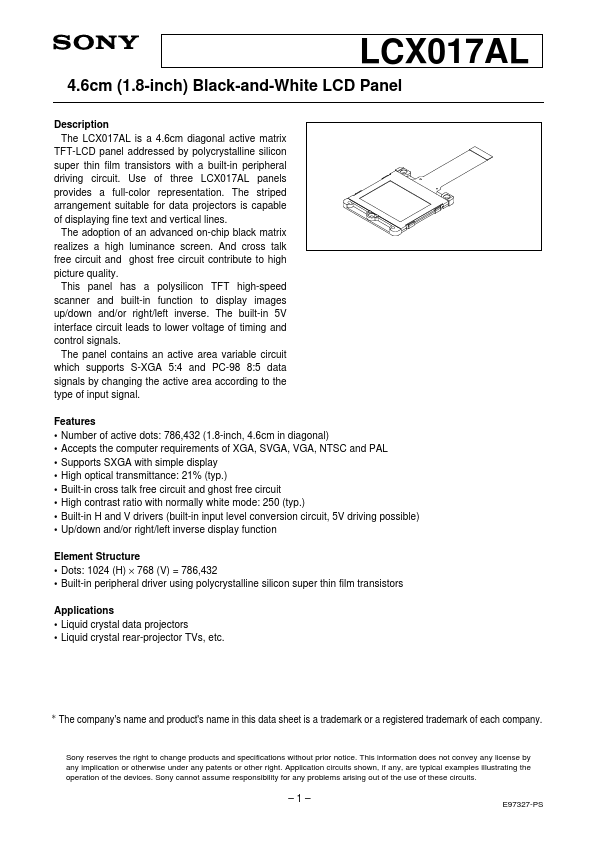
The LCX017AL is a 4.6cm diagonal active matrix
TFT-LCD panel addressed by polycrystalline silicon super thin film transistors with a built-in peripheral driving circuit. Use of three LCX017AL panels provides a full-color representation. The striped arrangement suitable for data projectors is capable of displaying fine text and vertical lines.
The adoption of an advanced on-chip black matrix realizes a high luminance screen. And cross talk free circuit and ghost free circuit contribute to high picture quality.
This panel has a polysilicon TFT high-speed scanner and built-in function to display images up/down and/or right/left inverse. The built-in 5V interface circuit leads to lower voltage of timing and control signals.
The panel contains an active area variable circuit which supports S-XGA 5:4 and PC-98 8:5 data signals by changing the active area according to the type of input signal.
Features
- Number of active dots: 786,432 (1.8-inch, 4.6cm in diagonal)
- Accepts the puter requirements of XGA, SVGA, VGA, NTSC and PAL
- Supports SXGA with simple display
- High optical transmittance: 21% (typ.)
- Built-in cross talk free circuit and ghost free circuit
- High contrast ratio with normally white mode: 250 (typ.)
- Built-in H and V drivers (built-in input level conversion circuit, 5V driving possible)
- Up/down and/or right/left inverse display function
Element Structure
- Dots: 1024 (H) × 768 (V) = 786,432
- Built-in peripheral driver using polycrystalline silicon super thin film transistors
Applications
- Liquid crystal data projectors
- Liquid crystal rear-projector TVs, etc.
∗ The pany's name and product's name in this data sheet is a trademark or a registered trademark of each pany.
Sony reserves the right to change products and specifications without prior notice. This information does not convey any license by any implication or otherwise under any patents or other right. Application circuits shown, if any, are typical examples illustrating the...