SLX-2043
SLX-2043 is High Linearity Low Noise Amplifier Module manufactured by Stanford Microdevices.
Description
The Stanford Microdevices’ SLX-2043 is a low noise amplifier module operating in the 1700
- 2500 MHz frequency band. This device has been optimized to serve high linearity basestation applications where a high intercept point is required with low noise figure. The SLX-2043 uses PHEMT device technology, internal bias circuitry, and proven ceramic module technology to yield a high performance product with proven reliability. Internal RF matching is also included on both the input and output to provide an easy to implement, unconditionally stable, 50 ohm circuit block.
1700-2500 MHz High Linearity Low Noise Amplifier Module
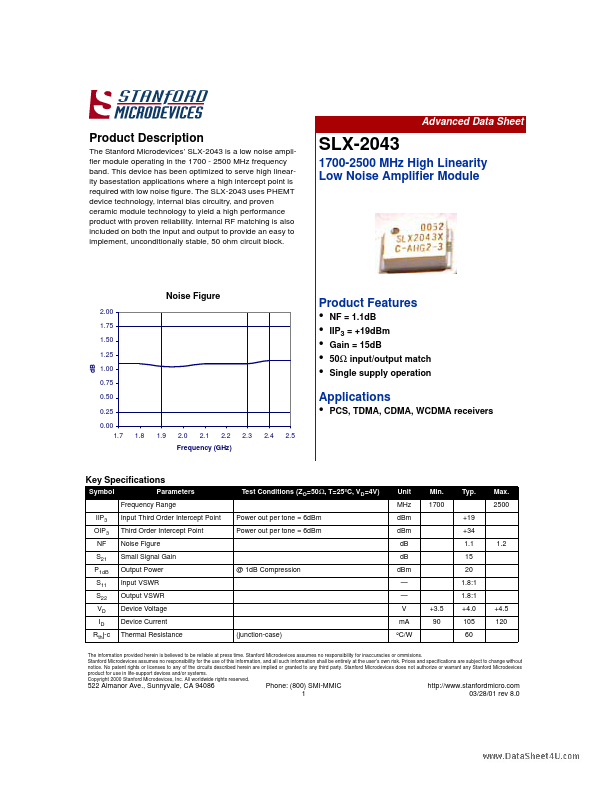
Noise Figure
2.00 1.75 1.50 1.25 d B 1.00 0.75 0.50 0.25 0.00 1.7 1.8 1.9 2.0 2.1 2.2 2.3 2.4 2.5 Frequency (GHz)
Product Features
- -
- -
- -
NF = 1.1d B IIP3 = +19d Bm Gain = 15d B 50Ω input/output match Single supply operation
Applications
PCS, TDMA, CDMA, WCDMA receivers
Key Specifications
Symbol Parameters Frequency Range IIP3 OIP3 NF S21 P1d B S11 S22 VD ID Rthj-c Input Third Order Intercept Point Third Order Intercept Point Noise Figure Small Signal Gain Output Power Input VSWR Output VSWR Device Voltage Device Current Thermal Resistance (junction-case) @ 1d B pression Power out per tone = 6d Bm Power out per tone = 6d Bm Test Conditions (ZO=50Ω, T=25ºC, VD=4V) Unit MHz d Bm d Bm d B d B d Bm
- - V m A ºC/W +3.5 90 Min. 1700 +19 +34 1.1 15 20 1.8:1 1.8:1 +4.0 105 60 +4.5 120 1.2 Typ. Max. 2500
The information provided herein is believed to be reliable at press time. Stanford Microdevices assumes no responsibility for inaccuracies or ommisions. Stanford Microdevices assumes no responsibility for the use of this information, and all such information shall be entirely at the user’s own risk. Prices and specifications are subject to change without notice. No patent rights or licenses to any of the circuits described herein are implied or granted to any third party. Stanford Microdevices does not authorize or warrant any Stanford...