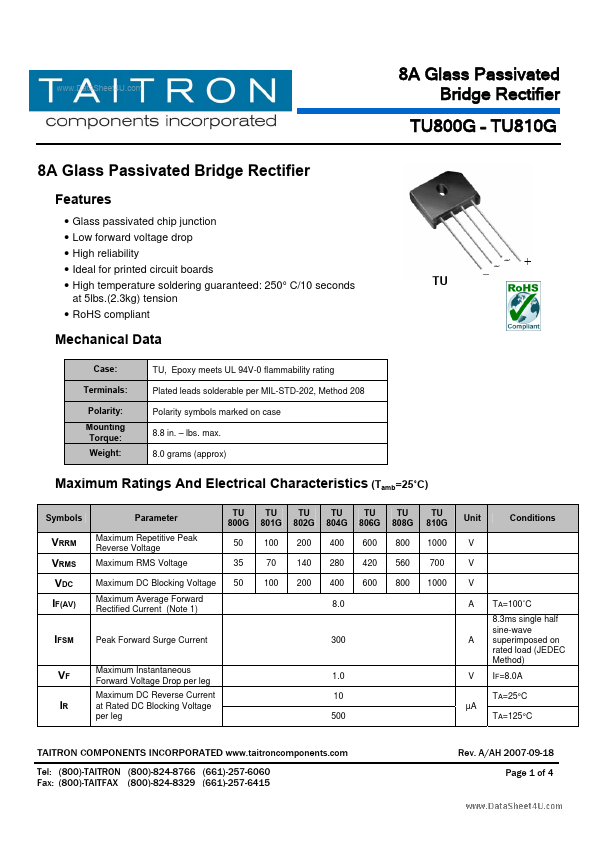
TU808G
TU808G is 8A Glass Passivated Bridge Rectifier manufactured by Taitron Components.
- Part of the TU800G comparator family.
- Part of the TU800G comparator family.
Features
Glass passivated chip junction Low forward voltage drop High reliability Ideal for printed circuit boards High temperature soldering guaranteed: 250° C/10 seconds at 5lbs.(2.3kg) tension
- Ro HS pliant
- -
- -
- TU
Mechanical Data
Case: Terminals: Polarity: Mounting Torque: Weight: TU, Epoxy meets UL 94V-0 flammability rating Plated leads solderable per MIL-STD-202, Method 208 Polarity symbols marked on case 8.8 in.
- lbs. max. 8.0 grams (approx)
Maximum Ratings And Electrical Characteristics (Tamb=25˚C)
Symbols Parameter Maximum Repetitive Peak Reverse Voltage Maximum RMS Voltage Maximum DC Blocking Voltage Maximum Average Forward Rectified Current (Note 1) TU 800G 50 35 50 TU 801G 100 70 100 TU 802G 200 140 200 TU 804G 400 280 400 8.0 TU 806G 600 420 600 TU 808G 800 560 800 TU 810G 1000 700 1000 Unit V V V A TA=100˚C 8.3ms single half sine-wave superimposed on rated load (JEDEC Method) IF=8.0A TA=25°C µA 500 TA=125°C Conditions
VRRM VRMS VDC IF(AV) IFSM VF IR
Peak Forward Surge Current
Maximum Instantaneous Forward Voltage Drop per leg Maximum DC Reverse Current at Rated DC Blocking Voltage per leg
1.0 10
TAITRON PONENTS INCORPORATED .taitronponents.
Tel: (800)-TAITRON (800)-824-8766 (661)-257-6060 Fax: (800)-TAITFAX (800)-824-8329 (661)-257-6415
Rev. A/AH 2007-09-18 Page 1 of 4
..
8A Glass Passivated Bridge Rectifier TU800G
- TU810G
Symbols
Parameter Rating for Fusing (1ms<t<8.3ms) Typical Thermal Resistance per leg Typical Thermal Resistance per leg Operating and Storage Temperature Range
TU 800G
TU 801G
TU 802G
TU 804G 374 18 3.0 -55 to 150
TU 806G
TU 808G
TU 810G
Unit A²S ˚C/W ˚C/W ˚C
Conditions
I²t RθJA RθJC TJ,TSTG
(Note 2) (Note 1)
Note:
1. Mounted on 75 x 75 x 3.0mm Al. plate 2. Mounted on PCB at 9.5mm lead length with 12mm² copper pad 3. Single Phase, half wave, 60 Hz, resistive or inductive load. For capacitive load, derate current by 20%
Rating and Characteristic Curves
Fig.2-Max Non-Repetitive Peak Forward...