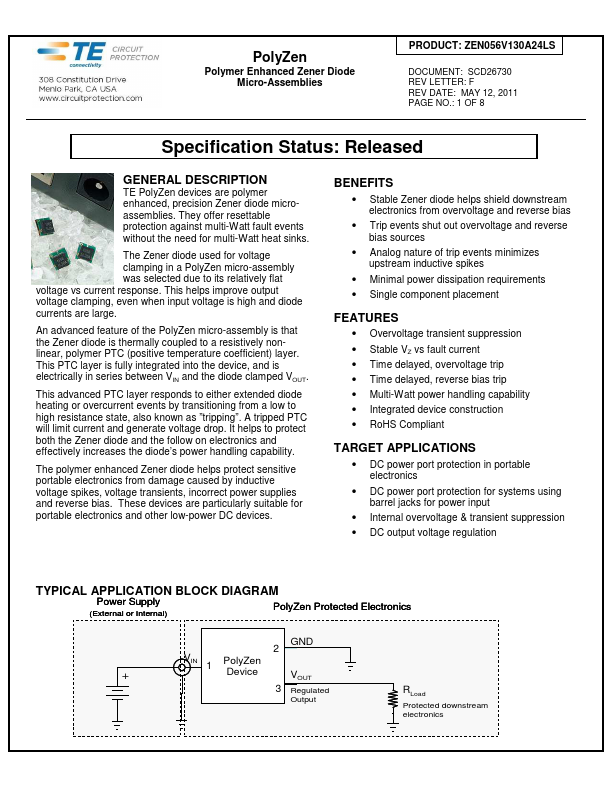
ZEN056V130A24LS
ZEN056V130A24LS is Polymer Enhanced Zener Diode manufactured by TE Connectivity.
Poly Zen
Polymer Enhanced Zener Diode Micro-Assemblies
PRODUCT: ZEN056V130A24LS
DOCUMENT: SCD26730 REV LETTER: F REV DATE: MAY 12, 2011 PAGE NO.: 1 OF 8
Specification Status: Released
GENERAL DESCRIPTION
TE Poly Zen devices are polymer enhanced, precision Zener diode microassemblies. They offer resettable protection against multi-Watt fault events without the need for multi-Watt heat sinks.
The Zener diode used for voltage clamping in a Poly Zen micro-assembly was selected due to its relatively flat voltage vs current response. This helps improve output voltage clamping, even when input voltage is high and diode currents are large.
An advanced feature of the Poly Zen micro-assembly is that the Zener diode is thermally coupled to a resistively nonlinear, polymer PTC (positive temperature coefficient) layer. This PTC layer is fully integrated into the device, and is electrically in series between VIN and the diode clamped VOUT.
This advanced PTC layer responds to either extended diode heating or overcurrent events by transitioning from a low to high resistance state, also known as ”tripping”. A tripped PTC will limit current and generate voltage drop. It helps to protect both the Zener diode and the follow on electronics and effectively increases the diode’s power handling capability.
The polymer enhanced Zener diode helps protect sensitive portable electronics from damage caused by inductive voltage spikes, voltage transients, incorrect power supplies and reverse bias. These devices are particularly suitable for portable electronics and other low-power DC devices.
BENEFITS
- Stable Zener diode helps shield downstream electronics from overvoltage and reverse bias
- Trip events shut out overvoltage and reverse bias sources
- Analog nature of trip events minimizes upstream inductive spikes
- Minimal power dissipation requirements
- Single ponent placement
Features
- Overvoltage transient suppression
- Stable VZ vs fault current
- Time delayed, overvoltage trip
-...