• Part: U2642B
  • Description: Intermittent- and Wipe/Wash Control
  • Manufacturer: TEMIC Semiconductors
  • Size: 139.98 KB
Download U2642B Datasheet PDF
TEMIC Semiconductors
U2642B
U2642B is Intermittent- and Wipe/Wash Control manufactured by TEMIC Semiconductors.
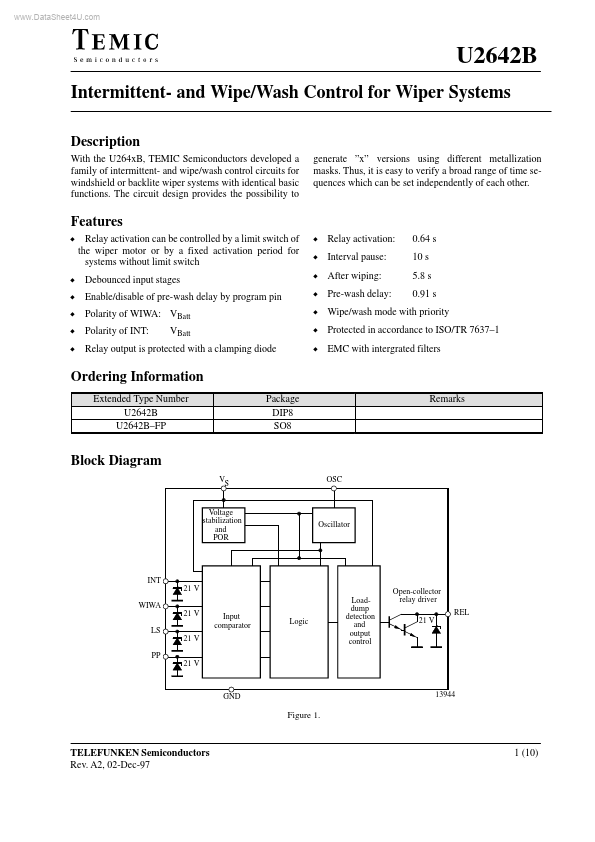
Description With the U264x B, TEMIC Semiconductors developed a family of intermittent- and wipe/wash control circuits for windshield or backlite wiper systems with identical basic functions. The circuit design provides the possibility to generate ”x” versions using different metallization masks. Thus, it is easy to verify a broad range of time sequences which can be set independently of each other. Features D Relay activation can be controlled by a limit switch of the wiper motor or by a fixed activation period for systems without limit switch D Debounced input stages D Enable/disable of pre-wash delay by program pin D Polarity of WIWA: VBatt D Polarity of INT: D Relay activation: D Interval pause: D After wiping: D Pre-wash delay: 0.64 s 10 s 5.8 s 0.91 s D Wipe/wash mode with priority D Protected in accordance to ISO/TR 7637- 1 D EMC with intergrated filters VBatt D Relay output is protected with a clamping diode Ordering Information Extended Type Number U2642B U2642B- FP Package DIP8 SO8 Remarks Block Diagram VS OSC Voltage stabilization and POR Oscillator INT 21 V WIWA 21 V LS 21 V PP 21 V Input parator Logic Loaddump detection and output control Open-collector relay driver REL 21 V Figure 1. TELEFUNKEN Semiconductors Rev. A2, 02-Dec-97 1 (10) Pin Configuration Pin 1 2 3 4 5 6 7 8 Symbol INT WIWA LS PP GND REL VS OSC Function Intermittent input Wipe/wash (WIWA) input Limit switch (wiper motor) input Program pin Ground Relay output Supply voltage RC oscillator input INT WIWA LS PP 1 2 3 4 8 7 6 5 OSC VS REL GND Figure 2. Pinning Functional Description All times specified below refer to an oscillator frequency of 200 Hz. Figures 2 to 9 show the dependencies of the times upon battery voltage and temperature. The temperature dependence of the oscillator frequency is essentially determined by the temperature coefficient of the oscillator capacitor. The temperature dependence of the oscillator frequency can be reduced to minimum...