

Datasheet4U Logo Datasheet4U.com

THCV214 - LVDS SerDes transmitter and receiver

This page provides the datasheet information for the THCV214, a member of the THCV213 LVDS SerDes transmitter and receiver family.

Description

THCV213 and THCV214 are designed to support pixel data transmission between the Host and Display.

The chipset can transmit 18bit data and 4bit control data through only a single differential cable at a pixel clock frequency from 5MHz to 40MHz.

Features

  • Transmit 18bit data and 4bit control data via a single differential cable.
  • Wide frequency range: 5MHz to 40MHz.
  • Support SYNC pattern and LOCK indicator.
  • Pre Emphasis mode.
  • Clock edge selectable.
  • Dual Display mode.
  • Power Down mode.
  • Low power single 3.3V CMOS design.
  • 48pin TQFP.
  • AEC-Q100 ESD Protection.
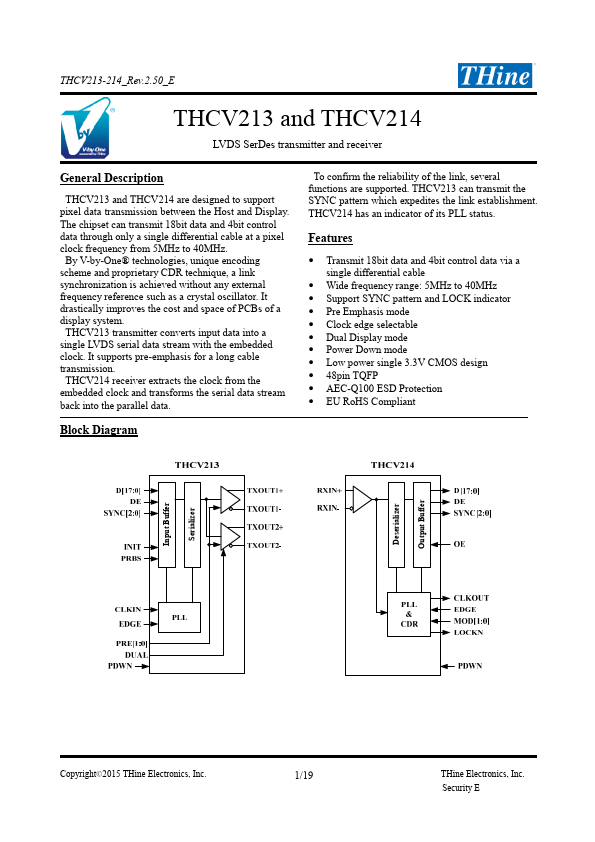
  • EU RoHS Compliant Block Diagram Input Buffer Serializer Deserializer Output Buffer Copyright©2015 THine Electronics, Inc. 1/19 THine Ele.

📥 Download Datasheet

Datasheet preview – THCV214

Datasheet Details

Part number THCV214
Manufacturer THine Electronics
File Size 810.17 KB
Description LVDS SerDes transmitter and receiver
Datasheet download datasheet THCV214 Datasheet
Additional preview pages of the THCV214 datasheet.
Other Datasheets by THine Electronics

Full PDF Text Transcription

Click to expand full text
THCV213-214_Rev.2.50_E THCV213 and THCV214 LVDS SerDes transmitter and receiver General Description THCV213 and THCV214 are designed to support pixel data transmission between the Host and Display. The chipset can transmit 18bit data and 4bit control data through only a single differential cable at a pixel clock frequency from 5MHz to 40MHz. By V-by-One® technologies, unique encoding scheme and proprietary CDR technique, a link synchronization is achieved without any external frequency reference such as a crystal oscillator. It drastically improves the cost and space of PCBs of a display system. THCV213 transmitter converts input data into a single LVDS serial data stream with the embedded clock. It supports pre-emphasis for a long cable transmission.
Published: |