
Datasheet4U Logo Datasheet4U.com

XC62EP5002 - Boosting Voltage Regulators

Download the XC62EP5002 datasheet PDF (XC62E included). The manufacturer datasheet provides complete specifications, pinout details, electrical characteristics, and typical applications for boosting voltage regulators.

Description

The XC62E series are a group of positive output voltage regulators that can supply up to 1A of output current using an external transistor.
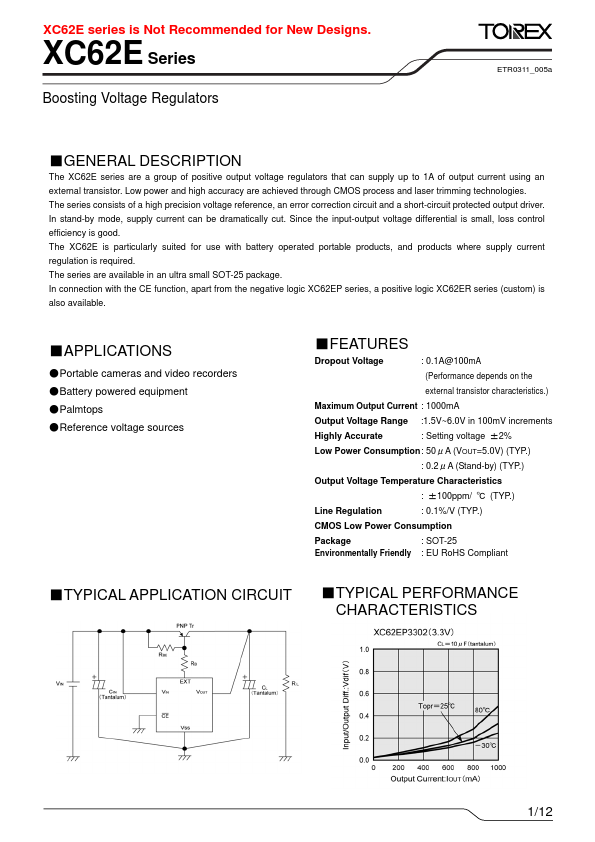

Low power and high accuracy are achieved through CMOS process and laser trimming technologies.

Features

  • Dropout Voltage : 0.1A@100mA (Performance depends on the external transistor characteristics. ) Maximum Output Current : 1000mA Output Voltage Range :1.5V~6.0V in 100mV increments Highly Accurate : Setting voltage ±2% Low Power Consumption: 50μA (VOUT=5.0V) (TYP. ) : 0.2μA (Stand-by) (TYP. ) Output Voltage Temperature Characteristics : ±100ppm/ ℃ (TYP. ) Line Regulation : 0.1%/V (TYP. ) CMOS Low Power Consumption Package : SOT-25 Environmentally Friendly : EU RoHS Compliant.
  • T.

📥 Download Datasheet

Note: The manufacturer provides a single datasheet file (XC62E-TorexSemiconductor.pdf) that lists specifications for multiple related part numbers.
Other Datasheets by Torex Semiconductor

Full PDF Text Transcription

Click to expand full text
XC62E series is Not Recommended for New Designs. XC62E Series Boosting Voltage Regulators ETR0311_005a ■GENERAL DESCRIPTION The XC62E series are a group of positive output voltage regulators that can supply up to 1A of output current using an external transistor. Low power and high accuracy are achieved through CMOS process and laser trimming technologies. The series consists of a high precision voltage reference, an error correction circuit and a short-circuit protected output driver. In stand-by mode, supply current can be dramatically cut. Since the input-output voltage differential is small, loss control efficiency is good. The XC62E is particularly suited for use with battery operated portable products, and products where supply current regulation is required.
Published: |